Onton 發布 Ontology 1:神經符號搜尋模型,準確度比全球最佳電商搜尋引擎高出 2.7 倍
重點摘要
總部位於舊金山的搜尋與探索公司 Onton 發布了 Ontology 1,這是一個用於複雜、對話式、多模態商品搜尋的神經符號模型。在由三個獨立 LLM 評審評分的 90 個查詢基準測試中,Ontology 1 的平均 precision@10 達到 0.630,而 Google Shopping 為 0.543,Amazon 為 0.469。且這是在僅索引其目錄約 1% 的情況下達成的。它是否可部署?可以,但不是以可下載的權重形式。Ontology 1 已在 Onton.com 對終端用戶上線,Onton 表示合作夥伴存取會針對在代理式網路上建構的團隊逐案授予。目前沒有公開 API、定價層級或開放檢查點。現階段的採用看起來像是夥伴關係,而非 pip install。適合的企業:中階市場與企業級零售商、市集及代理式商務相關團隊。
Onton, a San Francisco-based search and discovery company, has released Ontology 1, a neurosymbolic model for complex, conversational, multimodal product search. On a 90-query benchmark scored by three independent LLM judges, Ontology 1 reached a mean precision@10 of 0.630, against 0.543 for Google Shopping and 0.469 for Amazon. It did this while indexing roughly 1% of their catalogs. Is it deployable Yes, but not as weights you download. Ontology 1 is live for end users at Onton.com, and Onton says partner access is granted case by case for teams building on the agentic web. There is no public API, pricing tier, or open checkpoint for the model itself. Adoption today looks like a partnership, not a pip install. Company fit: Mid-market and enterprise retailers, marketplaces, and agentic-commerce platforms whose relevance stack already loses on long, requirements-heavy queries. Small catalogs see less benefit, because the failure mode Ontology 1 targets scales with catalog size and listing noise. Industries: Home decor and furniture today, since that is the only vertical Onton indexes. Onton states the methodology generalizes beyond e-commerce, and that Ontology searches non-product data with essentially no reconfiguration. Applications: Conversational and multimodal site search, moodboard-driven discovery, negation-heavy filtering, listing and review trust scoring, and grounding layers for shopping agents. Why keyword and vector retrieval break here Conventional e-commerce assumes intent maps onto categories and attributes: size, price, material, brand. There is no filter for ‘pet-friendly,’ and none for furniture that fits your room. Onton argues this catalog interface has barely changed in nearly 30 years. Ontology 1 takes a different route. For ‘pet-friendly sectional,’ it does not trust the seller’s label, which may be absent or untrue. It reasons from properties more likely to be objective — fiber, weave, construction — and flags claims the product data contradicts. It also weighs the source, since some listings game the algorithm and some reviews are bought. The model builds an explicit, inspectable world model rather than absorbing patterns into weights. When it has no account of ‘pet-friendly,’ it treats that as a gap and works the answer out: cleanability and durability, then polyester upholstery as an indicator. The learning is reused on later queries such as ‘pet-friendly chair’ or ‘cleanable blue couch,’ and the loop runs continuously. The benchmark: Subtext-Decor-90 Onton released Subtext-Decor-90 with code and data. Three multimodal judges: Claude Opus 4.8, Gemini 3.1 Pro and GPT-5.5, scored the top 10 visible result cards returned by Onton, Amazon and Google Shopping for each of 90 text queries. P@10 was averaged across judges, with 95% confidence intervals from 10,000 bootstrap resamples. Results: Onton 0.630 [0.571, 0.688], Google Shopping 0.543 [0.490, 0.596], Amazon 0.469 [0.417, 0.521]. Onton won 52 queries outright, Google 19, Amazon 16. Those sum to 87 because Ontology returned fewer than 10 results on three queries, and empty slots were scored as non-relevant. Excluding those slots instead gives Onton 0.665, Google 0.549, Amazon 0.459. Krippendorff’s alpha across the three judges is 0.465, so absolute P@10 values are noisy and judge-dependent. All three judges still place the engines in the same order. Image and multimodal queries were excluded from the 90, because Amazon Lens does not support multimodal queries and Google Lens does not return products exclusively. Onton reports a separate 10-query image and multimodal comparison against Google. Where Ontology 1 loses Failure cases cluster on functional-spec queries where Amazon’s category metadata dominates: ‘lamp that won’t wake my partner if I read at 3am’ (Onton 0.4, Amazon 0.9) and ‘something to put on a weirdly deep windowsill’ (Onton 0.07, Amazon 0.67). Onton attributes this to catalog breadth and its single-vertical, non-sponsored index, and expects the self-learning loop to narrow the gap. The infrastructure underneath Ontology 1’s knowledge graph runs on Ograph, a custom graph database. Onton reports one Ograph core beating SuiteSparse:GraphBLAS running on 14 cores, roughly 100× the throughput per core, and a GPU build running 43× faster than the CPU variant, with early runs touching 1000× as the implementation is tuned. Interactive explainer The embed below walks through the same material in four panels: real Subtext-Decor-90 queries with per-query scores, the pet-friendly reasoning graph drawn step by step, the self-learning loop, and the benchmark chart with confidence intervals and alternate scoring views. (function(){ window.addEventListener("message", function(e){ var d = e && e.data; if(!d) return; var h = d.ontologyHeight || d.frameHeight; if(!h) return; var f = document.getElementById("ontology1-frame"); if(f) f.style.height = h + "px"; }, false); })(); Key Takeaways Ontology 1 scores P@10 0.630 on Subtext-Decor-90, ahead of Google Shopping (0.543) and Amazon (0.469). It wins 52 of 90 queries outright while indexing roughly 1% of either competitor’s catalog. The architecture is neurosymbolic: an inspectable knowledge graph that decomposes vague predicates into checkable properties. Judge reliability is modest (Krippendorff’s alpha 0.465), but all three judges rank the engines identically. Availability is product-first — live on Onton.com, partner access case by case, no open weights or public API. Check out the Technical details and Benchmarks. Also, feel free to follow us on Twitter and don’t forget to join our 150k+ML SubReddit and Subscribe to our Newsletter. Wait! are you on telegram? now you can join us on telegram as well. Need to partner with us for promoting your GitHub Repo OR Hugging Face Page OR Product Release OR Webinar etc.? Connect with us The post Onton Releases Ontology 1: A Neurosymbolic Search Model That is 2.7x More Accurate than the World’s Best E-commerce Search Engines appeared first on MarkTechPost.
Related
相關文章

全世界最強的 AI,都在「抄」這群普通人的作業
這兩天,AI 圈可說是百家爭鳴,GPT-6 曝光、DeepSeek V4 Flash 公測、SD2.5 發佈、MiniMax 多模態開源視頻模型問世,各家技術進展紛紛搶佔版面。但我們今天想將頭條留給一個名不見經傳的人,《紐約客》的特稿稱他為「互聯網大腦的意外締造者」。他是一個普通人,卻在維基百科上編輯了超過 600 萬次。 2021 年 1 月,英語維基百科完成了第 10 億次可追蹤編輯。這個里程碑並非誕生於一篇宏大的新詞條,編輯者只是在某張冷門電子音樂專輯的頁面上補上一條鏈接。
趕超 NVIDIA:傳聞谷歌規劃 2028 年部署 1200~1500 萬顆 TPU v9 AI 芯片
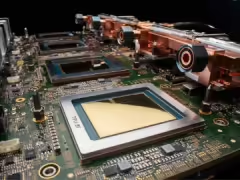
根據外媒報導,Google 正積極擴張自研 AI 晶片布局,目標在 2028 年部署高達 1200 萬至 1500 萬顆自家的 TPU v9 加速器。這項消息源自一份市場分析報告,雖然報告來源未經證實,但已引發業界高度關注,認為 Google 有機會在 AI 晶片出貨規模上與 NVIDIA 平起平坐,甚至超越。 分析報告指出,NVIDIA 在 2028 年的 AI GPU 出貨量預估約為 1240 萬顆。

Edge AI Daily 早報(8月3日)
Snap宣布以2195美元推出消費級AR眼鏡Specs,搶在Meta前一週發布,標誌AR大眾市場的重要轉折。Figure AI第三代機器人F.03實現完全自主爬梯,突破感知與平衡瓶頸,朝商業落地邁進。此外,OpenAI因產品迭代引發用戶對GPT-4o的情感依戀衝突,而疑似AI生成的歌曲《Rubberz》衝上Billboard第58名,凸顯音樂真實性與檢測機制的挑戰。

2026,千問元寶靜悄悄
2026年已經過了一半,AI賽道的熱鬧程度絲毫不減,只是站在聚光燈下的主角,悄悄換了一批面孔。七月中旬,月之暗面推出的Kimi K3,以2.8萬億參數的規模成為全球最大的開源模型,加上原生視覺理解能力與百萬級上下文窗口,話題性十足;幾乎同一時間,DeepSeek V4「滿血版」啟動灰度測試,性能被認為直追OpenAI GPT-5.6。而在另一端,QuestMobile數據顯示豆包6月月活已達3.82億,呈現斷層式領先。相較之下,去年還占據話題中心的千問與元寶,聲量彷彿在一夜之間收窄了許多。

誰在製造AI“虛假繁榮”?
獨立分析師艾德·齊特隆(Ed Zitron)近日以一份數據與邏輯兼具的研究報告,對當前由科技巨頭主導的AI投資熱潮發出迄今最嚴厲的警告。他直指支撐股價飛漲的AI敘事,可能是一場建立在「循環融資」基礎上的不可持續騙局,所有人「都被賣了一個謊言」。 齊特隆引用瑞銀分析師史蒂芬·周的數據,揭露雲端服務商收入結構中一個不為人知的真相:今年谷歌雲約有27%的營收來自OpenAI與Anthropic兩家公司,到2027年,這個比例預計將飆升至48%以上。
xAI升級 Imagine Video1.5:新增圖像語音參考與原生1080p視頻生成
xAI 為視頻生成模型 Imagine Video 1.5 推出重大升級,新增圖像參考、語音參考、純文本生成影片與原生 1080p 輸出能力,強化角色一致性與場景控制。目前文字轉影片與 1080p 功能已於 Grok Imagine 網頁版、iOS 及 Android 上線,圖像與語音參考功能率先提供給美國地區 SuperGrok Heavy 與 SuperGrok Plus 用戶,並計劃後續擴大覆蓋範圍。