Cursor 開源 Mixture-of-Kittens (MoK):專為 GB300 NVL72 機架設計的確定性 MoE 訓練巨內核
重點摘要
Cursor Research 正式開源 Mixture-of-Kittens(MoK),這是其 Composer 模型背後的混合專家(MoE)訓練巨內核。MoK 將所有 MoE 通訊與計算步驟融合為單一確定性內核。據 Cursor 團隊報告,其吞吐量最高可達最強公開基準的 2.37 倍,目前已支援數萬顆 GPU 的 Composer 訓練。部署門檻較高:需 NVIDIA Blackwell SM100 或 SM103 GPU(即 GB200 NVL72 或 GB300 NVL72 機架),並要求 Python 3.12+、PyTorch 2.10+ 及 CUDA toolkit 13.0+,且 GPU 間緩衝區依賴 PyTorch 對稱記憶體。因此,實際採用者限於擁有或租用 NVL72 容量的機構,如前沿實驗室與資金充足的模型新創公司。MoK 以 Apache-2.0 授權發布於 GitHub。
Cursor Research has open-sourced Mixture-of-Kittens (MoK), the mixture-of-experts training megakernel behind its Composer models.MoK fuses every MoE communication and computation step into a single deterministic kernel.Cursor team reports up to 2.
37x higher throughput than the strongest public baseline.It already powers Composer training across tens of thousands of GPUs.Is it deployable Yes, but the hardware floor is high.MoK is on GitHub under Apache-2.0.
It requires NVIDIA Blackwell SM100 or SM103 GPUs, which means GB200 NVL72 or GB300 NVL72 racks.It also needs Python 3.12+, PyTorch 2.10+, and CUDA toolkit 13.0+.Inter-GPU buffers rely on PyTorch symmetric memory.That limits realistic adopters to organizations that own or rent NVL72 capacity.
Frontier labs, funded model startups, GPU neoclouds, and national computing centers fit.Single-node teams and 8-GPU shops do not.Applications are narrow but high-value.They include pretraining and post-training of DeepSeek-V3-style MoE models.
Determinism also makes it useful for on-policy RL post-training and internal ablations.Relevant industries are AI model development, cloud GPU infrastructure, code-generation tooling, and quantitative research.MoE layer as the bottleneck Cursor’s earlier work covered the compute side.
The research team wrote its own MXFP8 and NVFP4 training kernels and a ‘warp decode’ path for MoE inference.Those assumed inter-GPU communication was handled separately.In production, communication became the limiting factor.The MoE layer can consume more than half of end-to-end training time.
Moving to GB300 NVL72s changed the problem again.A rack is 72 GPUs inside one NVLink domain, which allows fine-grained overlap.But the integrated Grace CPUs are slow relative to the GPUs.CPU-GPU synchronization therefore has to be minimized aggressively.
Three design decisions that matter Communication direction is chosen per operation: Existing approaches such as DeepEP lean on push-based transfers.Cursor’s microbenchmarks show push moves fewer total bytes in one direction.That leaves the reverse NVLink lane mostly idle.
Pull-based dispatch delivers up to 29% higher NVLink bandwidth utilization under expert imbalance.It also eliminates cross-GPU completion signals.Push dispatch signalling measured 103 µs against 18 µs for pull, roughly 5.8x.
MoK therefore uses pull-based forward dispatch and push-based forward combine.The backward pass mirrors this with pull reverse-combine and push reverse-dispatch.One schedule table serves all four, costing under 3% of MoE runtime.
Overlap granularity sits between the extremes: Comet is fine-grained; DeepEP is coarse-grained.Cursor team argues the optimum is in the middle and workload-dependent.The heuristic targets at least two full SM waves per expert-grouped GEMM.For Kimi 2.5 shapes, the base model for Composer 2.
5, the floor is 2,368 tokens.Measured latency matches that estimate closely.A ring token buffer removes the CPU from the loop: The alternatives are dropping tokens or asking the CPU to size buffers.MoK instead cycles a fixed ring buffer of a few hundred megabytes.
It does so at minibatch granularity, interleaving dispatch and combine at macrobatch boundaries.The ring is walked in reverse to minimize forward activation replay during backward.MoK is built as a megakernel and is fully deterministic.It supports BF16 and MXFP8 precision modes.
Scheduling runs through Blackwell’s Cluster Launch Control, so inter-rack RDMA does not serialize behind it.Router weight gradients use a SonicMoE-style calculation fused into the SwiGLU backward.https://cursor.
com/blog/mixture-of-kittens Results Layer benchmarks ran in a single NVL72 rack at EP degree 64.Each GPU held 2,048 tokens before routing.Baselines were NCCL+PyTorch, DeepEP+PyTorch, DeepEP+TransformerEngine, and HybridEP+Megatron.Shapes covered Kimi K2.7 Code, GLM-5.2, Qwen3.
5-397B-A17B, and DeepSeek-V4-Pro.Against the fastest baseline, MoK is up to 2.37x faster for MXFP8 forward.The other figures are 1.78x MXFP8 backward, 1.92x BF16 forward, and 1.58x BF16 backward.End-to-end testing used 512 GPUs across several GB300 NVL72 racks.
Tokens per second per GPU rose from 760.9 to 1,070.2, a 1.41x gain.(function(){ window.addEventListener("message", function(e){ if(!e.data || typeof e.data.mokHeight !== "number") return; var f = document.getElementById("mtp-mok-frame"); if(f) f.style.height = e.data.
mokHeight + "px"; }); })(); Key Takeaways MoK fuses all MoE communication and computation into one deterministic megakernel for NVL72 racks.Pull dispatch plus push combine cuts signalling from 103 µs to 18 µs.A ring token buffer drops zero tokens and removes CPU-GPU synchronization entirely.Up to 2.
37x over the fastest public baseline; 1.41x end-to-end on 512 GPUs.Apache-2.0, but it demands Blackwell SM100/SM103, CUDA 13.0+, and PyTorch 2.10+.Check out the GitHub Repo and Technical details.
Also, feel free to follow us on Twitter and don’t forget to join our 150k+ML SubReddit and Subscribe to our Newsletter.Wait!are you on telegram?now you can join us on telegram as well.Need to partner with us for promoting your GitHub Repo OR Hugging Face Page OR Product Release OR Webinar etc.?
Connect with us The post Cursor Open-Sources Mixture-of-Kittens (MoK): A Deterministic MoE Training Megakernel for GB300 NVL72 Racks appeared first on MarkTechPost.
Related
相關文章

天才,對AI發展到底有多重要?
加拿大三位科學家傑弗裡·辛頓、約書亞·本希奧和理查德·薩頓對當代人工智慧發展有重大貢獻,凸顯少數天才就能左右一個國家的技術地位。文章從1956年達特茅斯會議談起,探討人工智慧領域的關鍵爭論與發展脈絡。

微軟 Copilot 新版圖標洩露,趨向扁平化、設計更簡潔
微軟 Copilot 圖標在 Edge Canary 測試版中意外曝光,新設計去除了 3D 陰影,變得更加扁平化。據悉,該圖標還曾短暫出現在新版 Microsoft 365 應用中,但上線時間尚未確定。#微軟Copilot#

Jeff Dean們,趕在貝葉斯AI到來之前跳船
Jeff Dean 離開任職27年的Google,創辦Discovery Loop公司,目標是讓AI進入持續運行的科學發現循環。Google DeepMind論文《LLM can't jump》指出,科學發現需要從經驗事實跳躍到新原則,而當前大型語言模型缺乏這種跳躍能力。研究顯示貝葉斯AI時代即將到來,大廠正積極補足Agent的基礎建設。
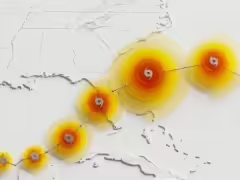
谷歌推出 WeatherNext 氣旋模型,AI 高精度預報颶風平均提前 24 小時
首頁 > 智能時代>人工智能 谷歌推出 WeatherNext 氣旋模型,AI 高精度預報颶風平均提前 24 小時 2026/8/7 14:11:01 來源:IT之家 作者:故淵 責編:故淵 評論: IT之家 8 月 7 日消息,谷歌 DeepMind 團隊昨日(8 月 7 日)發佈博文,宣佈推出 WeatherNext Cyclones 天氣預測模型,主要。

Meta重新支稜起來了?純推理拿下五項奧賽金牌,兩項滿分
Meta近期在人工智慧領域展現出驚人實力,其開發的純推理模型在國際數學奧林匹亞競賽中一舉奪下五面金牌,其中兩項更獲得滿分成績。這項成果不僅凸顯了Meta在AI推理能力上的突破,也讓外界重新審視這家科技巨頭在深度學習與邏輯運算方面的技術積累。 根據相關資訊,這款模型並未依賴外部知識庫或預先訓練的數據,而是透過純粹的推理機制來解決複雜數學問題。在競賽中,它成功應對多道高難度題目,涵蓋代數、幾何與數論等領域,最終以五項金牌的成績證明其演算法的有效性。其中兩項滿分表現,更顯示模型在特定題型上的精準度已達到頂尖水準。

智元下架了首席科學家羅劍嵐
智元機器人官網合夥人團隊名單中已移除首席科學家羅劍嵐,其個人社群簡介也不再提及智元職務,疑似離職,但官方尚未證實。羅劍嵐於2025年4月加入智元,任職約1年4個月,期間主導真機強化學習與具身智能研究,此次人事變動發生在公司啟動赴港上市流程之後。