Kimi K3 vs DeepSeek V4 Pro vs GLM-5.2: Open Trillion-Scale MoE Models Compared on Benchmarks, License, and Serving Cost
重點摘要
Three Chinese labs now hold the top of the open-weight leaderboard. Moonshot AI’s Kimi K3, DeepSeek V4 Pro, and Zhipu AI’s GLM-5.2 are all sparse Mixture-of-Experts (MoE) models with million-token context windows. Each targets long-horizon coding and agent workloads. This article compares them on three axes an AI team actually decides on: measured capability, license terms, and serving cost. ‘Trillion-parameter’ fits Kimi K3 (2.8T) and DeepSeek V4 Pro (1.6T). GLM-5.2 is 744B total, so it is the smallest of the three by total parameters. It earns its place because it led the open-weight field before K3 shipped. (function(){ var frame=document.getElementById("mtpc-embed-frame"); window.addEventListener("message",function(e){ if(e&&e.data&&e.data.mtpcHeight&&frame){ frame.style.height=e.data.
Three Chinese labs now hold the top of the open-weight leaderboard. Moonshot AI’s Kimi K3, DeepSeek V4 Pro, and Zhipu AI’s GLM-5.2 are all sparse Mixture-of-Experts (MoE) models with million-token context windows. Each targets long-horizon coding and agent workloads. This article compares them on three axes an AI team actually decides on: measured capability, license terms, and serving cost. ‘Trillion-parameter’ fits Kimi K3 (2.8T) and DeepSeek V4 Pro (1.6T). GLM-5.2 is 744B total, so it is the smallest of the three by total parameters. It earns its place because it led the open-weight field before K3 shipped. (function(){ var frame=document.getElementById("mtpc-embed-frame"); window.addEventListener("message",function(e){ if(e&&e.data&&e.data.mtpcHeight&&frame){ frame.style.height=e.data.mtpcHeight+"px"; } }); })(); The three contenders Kimi K3 is a 2.8-trillion-parameter Stable LatentMoE model activating 16 of 896 experts per token. Moonshot has not published the exact active-parameter count. K3 adds native vision, a 1M-token context window, and always-on reasoning. Moonshot calls it the first open 3T-class model. Our launch coverage is here. DeepSeek V4 Pro is a 1.6-trillion-parameter MoE with 49B active parameters, using 384 routed experts plus one shared expert. It carries a 1M-token context window with 384K max output. A smaller V4 Flash variant (284B total, 13B active) covers cheaper workloads. Weights are on Hugging Face. GLM-5.2 is a 744-billion-parameter MoE with roughly 40B active parameters and a 1M-token context window. Zhipu ships it with High and Max reasoning modes. It comes with API access SpecKimi K3DeepSeek V4 ProGLM-5.2Total parameters2.8T1.6T744B (753B per Artificial Analysis)Active parametersNot disclosed (16/896 experts)49B~40BContext window1M1M (384K max output)1M (131K max output)ModalityText + vision + videoTextTextReleasedJuly 16, 2026April 24, 2026June 13, 2026 Benchmarks Vendor-reported scores use different harnesses, so per-benchmark numbers rarely line up cleanly across labs. The neutral comparator is the Artificial Analysis Intelligence Index, which scores all three on the same suite. On that index, Kimi K3 scores about 57, DeepSeek V4 Pro (Max reasoning) scores 44, and GLM-5.2 scores 51. K3 ranks #3 overall, behind only Claude Fable 5 and GPT-5.6 Sol, and comparable to Opus 4.8 and GPT-5.5. GLM-5.2 held the top open-weight spot until K3 shipped. Coding benchmarks tell a similar story with caveats. Moonshot’s own table runs K3 and GLM-5.2 through matched harnesses. There, K3 leads GLM-5.2 on every shared benchmark by wide margins. Benchmark (Moonshot harness)Kimi K3GLM-5.2DeepSWE67.546.2Program Bench77.863.7Terminal Bench 2.188.382.7FrontierSWE81.267.3SWE Marathon42.013.0Automation Bench30.812.9GPQA-Diamond93.591.2 DeepSeek does not appear in Moonshot’s table, so its numbers come from separate testing. DeepSeek-V4-Pro-Max scores 80.6% on SWE-bench Verified, the highest open-weight result at its release and tied with Gemini 3.1 Pro. It also posts 83.5 on MRCR 1M, confirming serious long-context ability. GLM-5.2 scored 62.1 on SWE-bench Pro, edging GPT-5.5 at 58.6. So, K3 is the strongest of the three on measured capability. DeepSeek V4 Pro is competitive on isolated coding tasks. GLM-5.2 trails K3 but remains a capable open-weight option. License All three ship as open-weight models, but the practical status differs today. DeepSeek V4 Pro is MIT-licensed, with weights on Hugging Face from day one. GLM-5.2 is also MIT-licensed, with full weights on Hugging Face under the zai-org organization. Both allow unrestricted commercial use, fine-tuning, and self-hosting now. Kimi K3 is the exception. Moonshot has committed to publishing weights by July 27, 2026, expected under a Modified MIT license. Until then, K3 is usable only through the API and Kimi apps. Moonshot’s recent Modified MIT terms add one attribution clause. It triggers only above 100M monthly active users. Serving cost API list pricing separates these models sharply. ModelInput ($/MTok)Output ($/MTok)Cached inputKimi K33.0015.000.30DeepSeek V4 Pro0.4350.87~0.0036GLM-5.21.404.400.26 DeepSeek V4 Pro is the cost leader by a wide margin. At list output rates, one dollar buys roughly 1.15M output tokens from V4 Pro, about 227K from GLM-5.2, and about 67K from K3. Artificial Analysis prices every model on one blended 7:2:1 cache/input/output basis, which removes vendor framing. On that basis it lists K3 at $2.31 per 1M tokens, GLM-5.2 at $0.90, and DeepSeek V4 Pro at $0.18. On cost per task, the same source reports K3 at $0.94, GLM-5.2 at $0.32, and DeepSeek V4 Pro at $0.04. Speed also differs. Artificial Analysis measures GLM-5.2 at about 168 tokens/sec, well ahead of DeepSeek V4 Pro and Kimi K3 at about 62 each. Moonshot reports above 90% cache hits in coding workloads, which drops K3’s effective input cost to $0.30 per million. Self-hosting is a different constraint. GLM-5.2 at 744B needs over 1TB of VRAM in BF16, or roughly 8x H200 at FP8. DeepSeek V4 Pro at 1.6T needs more still. Kimi K3 is heaviest: Moonshot recommends 64 or more accelerators, putting local serving out of reach for most teams. K3 uses MXFP4 weights with MXFP8 activations for broader hardware support. (function(){ var frame=document.getElementById("mtph-embed-frame"); window.addEventListener("message",function(e){ if(e&&e.data&&e.data.mtphHeight&&frame){frame.style.height=e.data.mtphHeight+"px";} }); })(); Which model for which job For lowest cost per token at strong coding quality, DeepSeek V4 Pro is the clear pick. Its weights are downloadable, its license is clean, and its output price undercuts both rivals. For the highest measured capability, Kimi K3 leads, but at 5x to 17x the output price and no downloadable weights until July 27. GLM-5.2 sits between them: cheaper than K3, faster than both rivals, self-hostable today, and more capable than its size suggests. If you are planning to choose based on verification depth and license clarity favor DeepSeek and GLM now. Buyers chasing peak benchmark scores wait for K3 weights or pay the API premium. Key Takeaways Kimi K3 leads the Artificial Analysis Intelligence Index (~57, #3 overall) but stays API-only until July 27. DeepSeek V4 Pro is the cost leader: ~$0.04 per task and ~1.15M output tokens per dollar at list rates. GLM-5.2 (744B) is the smallest yet fastest (~168 t/s) and self-hostable today under MIT. All three ship 1M-token context; only DeepSeek and GLM have open weights available now. The post Kimi K3 vs DeepSeek V4 Pro vs GLM-5.2: Open Trillion-Scale MoE Models Compared on Benchmarks, License, and Serving Cost appeared first on MarkTechPost.
Related
相關文章
千問Qwen3.8官宣!2.4T參數開源,直指Fable 5
阿里旗下千問大模型宣布Qwen3.8即將發布並開源,參數規模達2.4T,號稱是除了Fable 5外最強大的模型。此外,近期Kimi-K3、DeepSeek-V4及MiniMax M3 Pro等國產大模型也陸續開源或發布,競爭激烈。

參數量達 2.4T,阿里千問 PC 端接入 Qwen3.8-Max-Preview
阿里千問推出 Qwen3.8-Max-Preview 預覽版,參數規模達 2.4T,已在 PC 端及 Web 端上線。該模型較前代旗艦 Qwen3.7-Max 能力顯著提升,在開發、數據分析等複雜任務中展現世界級實力。
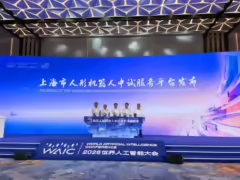
上海人形機器人中試服務平臺發佈,兼容輪臂機器人、四足機器人試製
首頁 > 智能時代>具身智能 上海人形機器人中試服務平臺發佈,兼容輪臂機器人、四足機器人試製 2026/7/19 16:54:47 來源:IT之家 作者:浩渺 責編:浩渺 評論: IT之家 7 月 19 日消息,7 月 18 日,2026 世界人工智能大會(WAIC),上海人形機器人中試服務平臺正式發佈。
阿里千問 Qwen3.8 預覽版模型上線:2.4T 參數量,宣稱“可能是除了 Fable 5 外最強大的模型”
阿里千問推出Qwen3.8-Max-Preview預覽版模型,參數量達2.4T,官方宣稱可能是除了Fable 5外最強大的模型。該模型已搶先上線阿里Token Plan、Qoder等平台,在內部複雜任務測評中展現出匹敵世界前沿模型的實力。
燧原科技聯閤中興通訊發佈雲燧 ESL64-O 超節點,自研 AI 芯片與架構創新降低互聯成本
燧原科技與中興通訊在2026世界人工智能大會聯合發布雲燧ESL64-O超節點,透過自研AI晶片與OEX正交無背板架構創新,大幅降低互聯成本。此外,燧原科技亦展示CoPoS先進封裝樣品,且已獲證監會同意在科創板上市,擬募集60億元用於AI晶片研發。

手機不會“消亡”,但它正在變成另一個物種 | WAIC觀察
手機不會“消亡”,但它正在變成另一個物種 | WAIC觀察AGI-Signal2026.07.19 15:21 · 來自上海全文6013字00:00 / 16:50手機這個過去十年“器官”一般的存在,正在經歷一次從內到外的重構。“手機會不會消亡?”不會。這是2026 WAIC上一場關於“智能硬件下一個十年”圓桌中,四位嘉賓的共識。