State of Open Models: Summer 2026 Observations
Back to Articles State of Open Models: Summer 2026 Observations Published August 14, 2026 Update on GitHub Upvote 1 Adina Yakefu AdinaY Follow Apolinário from multimodal AI art multimodalart Follow Irene Solaiman irenesolaiman Follow In the AI world, time feels compressed.
A few months after our spring report in our biannual analysis worked through the ecosystem, there are quite a few findings that we have observed until this summer.This report lays out these observations from January to August 2026 and presents the data behind each one.
Models and datasets on HF hub are growing on a daily basis.Public model repositories grew from 2.43 to 2.96 million over the period, datasets from 711,000 to 1 million, Spaces from 1.00 to 1.44 million.The distribution underneath stays extreme, roughly 85.
6% of models have fewer than 200 lifetime downloads, and 1.5% of repositories account for 99.2% of all downloads.Everything below happens inside that shape.1.
The frontier is moving fast There used to be a clear progression path: labs would start by releasing smaller models and gradually work their way toward the top end of the scale.In 2026, several Chinese labs skipped this progression entirely.
In almost every month of 2026, the largest and most performant open model from a Chinese lab was larger than anything an American lab released of its own.China's monthly ceiling ran between 754B and 2.
78 trillion parameters; America's own ceiling stayed under 130B in five of seven months, the exception being NVIDIA's Nemotron 3 Ultra at 561B in May and June, and Inkling from Thinking Machines Lab.The chart splits the labs into two camps.Moonshot, MiniMax, Xiaomi and Z.
ai publish almost nothing below 70B, so a developer's first encounter with them is a model too large to run on anything they own.Tencent and Alibaba Qwen cover the whole range instead, from under 1B upward.Two things made the first camp possible.Building large stopped being a differentiator.
Xiaomi and Meituan both cleared a trillion parameters this year, and neither was a household name in open weights twelve months ago.
And a lab no longer has to ship a small model to be reachable, because the community's quantization layer will make a large one runnable within days, a dependency we return to below.That leaves the size profile as a statement of intent rather than of capability.
A frontier only portfolio stakes everything on benchmark position and API demand.A full spectrum portfolio is a bid to be the family developers standardise on.Both are rational, they are playing for different prizes.The United States, meanwhile, is not absent from open source.
The two organizations publishing the most new open models this year are also the companies making the hardware: AMD and NVIDIA.Each released more than 200 new model repositories, far ahead of the rest of the field, with LiquidAI ranking third at around 100.
Hardware vendors have realized that open models are a way to sell chips: a model optimized for your hardware and freely available is the clearest proof that the hardware works.
When smaller models and embedding models are included, where Google, Microsoft, IBM Granite, and OpenAI’s older vision and speech models generate hundreds of millions of downloads annually, U.S.participation in open source AI is still growing.However, the center of gravity has shifted.
Google and Meta now rank well below NVIDIA in new model releases, despite being the companies that defined open model publishing in previous years.Meta’s move toward closed flagship models further highlights this change.Open source has moved from model labs to hardware and infrastructure companies.
At the frontier scale, the picture is very different.Most U.S.releases above 100B parameters this year are not new models, but built on top of Chinese models.
Only a few major original American models appear at this scale: Thinking Machines’ Inkling (952B), NVIDIA’s Nemotron 3 Ultra (561B), Nemotron 3 Super (124B), and Arcee AI’s Trinity-Large (399B).AMD contributed many conversions but no original model at this scale.
This work is still important: it enables trillion-parameter Chinese models to run efficiently on American hardware.But it represents a distribution and optimization layer rather than model creation.
Meanwhile, Chinese open models are increasingly optimized for domestic chips, the same competition in reverse, where models are designed around specific hardware ecosystems.2.Attention ≠ Adoption We took the top 25 model repositories by downloads accumulated this year and the top 25 by likes.
Exactly one repository appears in both lists.We counted downloads inside the window rather than lifetime, so nothing is credited for merely having existed longer, and controlling for age makes the split sharper.
Not one model published in 2026 reaches the download top 25, while thirteen of the twenty-five date from 2022.all-MiniLM-L6-v2 was pulled 1.55 billion times in seven months against 5,156 likes; Kimi-K3 was pulled about 60 times per like it received.The two numbers record different acts.
A like says a release matters, and goes to frontier models in the weeks after they ship.A download says something is wired into a pipeline that runs on a schedule, and accrues to small, stable models over years.
Likes are the right instrument for reading what the field is excited about, downloads for reading what it currently depends on.Treating either as a proxy for the other is the most common mistake we see in coverage of the Hub, including our own earlier work.
The same split appears at the level of the publisher.Chinese frontier labs are the only accounts on the Hub where the heavy band carries the volume.Effectively all of MiniMax's 2026 downloads are of models above 70B, along with 88% of Moonshot's, 55% of DeepSeek's and 39% of Z.ai's.
No large American account looks like this: Google, Microsoft and IBM Granite record essentially none of their 2026 downloads above 70B, and NVIDIA and Meta only 14% and 9%.The difference becomes clearer in total downloads.
Moonshot’s frontier-only portfolio recorded 37M downloads over the year, while Qwen’s broader release strategy across model sizes reached 2,045M (across repositories with declared parameter counts, 2,061M including all repositories) , about 55 times more.
The continued expansion of the family, from the 2.4T-parameter Qwen 3.8 Max to smaller variants such as 27B, shows the same focus on coverage across different use cases.Time also plays an important role.
Most models experience a sharp decline in usage after release, followed by a long tail of steady activity.A model’s adoption is largely determined within its first few months.
This helps explain why today’s download volume is often driven not by the newest releases, but by a smaller group of models that have become established infrastructure over time.3.
Open weights shift where value accumulates If frontier models were a licensing business, you would expect the biggest releases to carry the tightest terms.However, the data below shows a different story.Of 178 Chinese releases above 20B parameters this year, 59% carry Apache 2.
0 and 22% carry MIT, and exactly none carry a non-commercial restriction.DeepSeek and Z.ai ship models between 700 billion and 1.65 trillion parameters under plain MIT.
Chinese labs license their largest models about as permissively as their smallest, and more permissively than American labs license theirs: on the American side of the same size band, 29% is Apache or MIT, 41% sits under custom terms and 30% declares nothing at all.
Whatever these releases are for, it is not licence revenue.The weights are given away on the most permissive terms available.The return has to come from somewhere else: API and cloud business, hardware and platform positioning, or the ecosystem position itself.For instance, the valuations of Z.
ai and Kimi point to an effective open source strategy, getting traction and growth opportunities in the community.Going forward, however, the industry is likely to shift toward clearer monetization paths from open-source adoption.4.
Qwen has become the community's base model A model’s ecosystem position is not defined only by its own releases, but by how much the community builds on top of it.As mentioned above, Qwen is one exception which is getting attention and adoption.
Data from Hugging Face By this measure, Qwen has become one of the largest foundations in the open model ecosystem.Qwen-based models now account for 151,448 derivatives on the Hub, 2.6× Meta’s total footprint and 4.7× the Llama repositories specifically.Google follows with 82,506 derivatives.
The third-largest source is Unsloth, a community account publishing quantized and fine-tuning-ready builds, many of which further extend the Qwen ecosystem.
Qwen derivatives have increased at roughly 180–210 new repositories per day throughout the first seven months of 2026, showing that adoption is not driven only by individual launches.Qwen has become part of the default workflow for developers deciding what models to fine-tune and deploy.
Several factors contributed to this position.First, consistency.Qwen has maintained a regular release cadence, continuously updating its model family rather than relying on occasional flagship releases.Second, coverage.
It publishes models across a wide range of sizes and use cases, allowing developers to stay within the same ecosystem whether they need a small local model or a larger deployment model.Third, openness.Apache 2.0 licensing reduces friction for modification, redistribution, and commercial use.
These factors reinforce each other.A broad model family attracts more developers; more developers create more derivatives; and those derivatives make the ecosystem more attractive to future users.This position was built largely by the community.
The 151,448 derivatives represent downstream work created by other developers, not releases produced by Qwen itself.Even among the 28,531 GGUF conversions of Qwen models on the Hub, Qwen published only 54.5.
Small models remain the practical layer Among models that declare a parameter count, those under 1B take 83% of all-time downloads and everything above 100B takes 1%.Restricting to downloads accumulated in 2026 changes nothing: 3% of the volume goes to models above 70B.
This is the March finding that has held up most cleanly, for the same reason as before, small models are the only ones that run on the hardware most developers actually have.So how does a trillion-parameter model reach anyone at all?Through llama.cpp.
In February the ggml team joined Hugging Face, with the project remaining fully open-source, community-governed and in the same technical direction.What changed is that the most important project in local inference now has durable resources behind it.The ceiling moved with llama.cpp.
The July snapshot carries GGUF builds of DeepSeek-V4-Flash at roughly 284B parameters and Kimi-K3 at roughly 2.8 trillion.Local inference used to mean an 8B model on a laptop.
It now means a trillion-parameter mixture-of-experts spread across a few consumer machines, which is the alternative route the frontier did not have a year ago, and the reason a frontier-first release strategy is viable at all.And that route runs on Qwen: 39.
6 million GGUF downloads a month, nearly twice Gemma's 20.8 million and more than five times Llama's 7.5 million.The Llama gap is not a supply problem, Llama-derived GGUF repositories slightly outnumber Qwen's.Same shelf space, a fifth of the traffic.Model repositories grew 21.
5% over these seven months.Several things around them grew several times faster.Repositories declaring the gguf library rose 464%, lerobot 194% and Apple's mlx148%, against 16% for transformers and peft and 21% for diffusers.The modelling core is growing at roughly the platform average.
The layer that decides where a model can physicall
Related
相關文章

前保安殺進了AI決賽,高中生拿走25萬!這AI比賽辦得有點絕
! 他叫彭銘裕,今年24歲,之前從事的職業是保安。 而就是這麼與AI八竿子打不著邊的他,竟能從數萬人中殺出一條血路,直接斬獲全國第20強。 △《動動脖子》項目作者,彭銘裕 如此的反轉,還要從彭銘裕當保安那段時間說起。 當時,他刷抖音時被各種抖音特效給吸引注了,下班後便開始自己琢磨怎麼做特效。隨著一點點的經驗積累,也讓彭銘裕從小白新手走到了高級特效師。
全能開源王炸!谷歌Gemma下載量突破10億,AI深入生命禁區破解癌症治療密碼
當地時間8月20日,谷歌宣佈開源端側模型Gemma總下載量突破10億次,全球開發者衍生超10萬個定製變體,形成“Gemmaverse”開源生態。Gemma已突破對話生成邊界,深入多個垂直行業核心場景,成為開源AI領域標誌性里程碑。
FigmaTrace開源
Dataset Viewer Auto-converted to Parquet API Embed Duplicate Data Studio Subset (1) default · 3.47k rows default (3.47k rows) Split (2) train · 2.
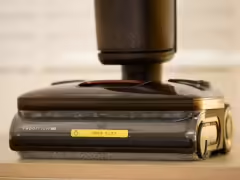
石頭 A30 Pro Steam 3.0 圖賞:180℃ 蒸汽與 90℃ 熱水加持,主打蒸熱雙洗
作者:馬卡 責編:馬卡 評論: 8 月 21 日消息,8 月 18 日,石頭旗下 A30 Pro Steam 3.0 洗地機正式開售,新品宣稱首次實現了 180℃ 活性蒸汽與 90℃ 高溫熱水的一鍵混洗,可在重度油汙環境使用,首發價 3299 元,購機可返 200 元現金,到手價 3099 元。

美政府機構警告:黑客正利用 AI 攻擊全美多地供水系統
作者:清源 責編:清源 評論: 8 月 20 日消息,據外媒 TechCrunch 今天(20 日)報道,美國供水系統近期接連遭遇網絡攻擊,美國網絡安全和基礎設施安全局(CISA)、美國聯邦調查局和美國國家安全局等安全機構警告,黑客正持續入侵關鍵基礎設施使用的西門子 S7 可編程邏輯控制器。

“AI焚書”,其實是個誤解
字母榜2026.08.19 17:00 · 來自山西全文4876字00:00 / 13:46“獲取知識,而非消除知識。文 | 字母榜在硅谷,“AI焚書”這件事,只能說是越鬧越瘋了。在最新的一篇報道中,媒體和二手書商合作,在一批被神秘買家訂走的書裡塞了一枚AirTag,一路追蹤,最後追到了亞馬遜位於拉斯維加斯的工廠。工廠員工表示,這是亞馬遜一個名為VGT3的項目,專門幹切書掃描那檔子事。一本二手書硬是走出了刑偵劇的路線。這事發展到現在,多少有點魔幻。