Prime Intellect 發布 Verifiers v1:用於代理強化學習訓練與評估的可組合任務集、工具套件及運行環境
重點摘要
Prime Intellect 推出了 verifiers 0.2.0 版本,並預覽了重新編寫的核心,以新的 verifiers.v1 命名空間發布。現代的評估能夠透過工具、壓縮和子代理來運行編碼代理。因此,v1 重建了環境,以規模化處理這些代理工作負載。什麼是 verifiers v1?首先,需瞭解 verifiers:它是 Prime Intellect 用於代理強化學習與評估的環境堆疊。過去,環境將數據、代理邏輯與基礎設施綑綁在一起。相比之下,v1 將這個綑綁拆分為三個可組合的部分:任務集定義工作內容(數據、工具與評分);工具套件解決任務並產生展開(可為 ReAct 迴路、CLI 代理或自訂);展開則在運行環境中執行(可為本地或雲端)。
Prime Intellect launched verifiers 0.2.0.It previews a rewritten core, shipped under the new verifiers.v1 namespace.Modern evaluations now run coding agents with tools, compaction, and subagents.Accordingly, v1 rebuilds environments to run these agentic workloads at scale.What is verifiers v1?
First, consider what verifiers is: Prime Intellect’s environment stack for agentic reinforcement learning and evaluations.Previously, an environment bundled its data, agent logic, and infrastructure together.In contrast, v1 breaks that bundle into three composable pieces.
A taskset defines the work: the data, tools, and scoring.A harness solves the task and produces a rollout.That harness can be a ReAct loop, a CLI agent, or your own.The rollout then runs inside a runtime, either local or in a sandbox.
Because the pieces decouple, any taskset runs under any compatible harness.How the Architecture Works?With those pieces defined, the next question is how they communicate.The central piece is the verifiers-managed interception server.It sits between the agent’s runtime and the inference server.
Specifically, it proxies requests to, and responses from, inference.Meanwhile, it records the trace, sets sampling parameters, and can rewrite tool responses.That rewriting helps mitigate reward hacks during training.For scale, each server multiplexes a constant number of rollouts, defaulting to 32.
A pool then scales elastically with observed concurrency.The server also owns a client that relays those requests.During evaluation, an EvalClient acts as a blind HTTP proxy.During training, a TrainClient wraps renderers for faithful token-in RL training.
Because harnesses speak different dialects, verifiers supports three as of now.These are OpenAI Chat Completions, OpenAI Responses, and Anthropic Messages.A dialect adapter normalizes each wire format into canonical vf.types.Consequently, your scoring logic stays independent of the agent tested.
Run rollout</button> <button id="vf-reset" class="vf-ghost">Reset</button> <span class="vf-lab">Harness dialect:</span> <select id="vf-dialect"> <option value="Chat">OpenAI Chat Completions</option> <option value="Resp">OpenAI Responses</option> <option value="Msg">Anthropic Messages</option> </select> </div> <div class="vf-stage"> <div class="vf-row" style="margin-bottom:14px"> <div class="vf-node vf-taskset" id="n-taskset"> <div class="vf-nt">Taskset</div> <div class="vf-nd">what · data · tools · scoring</div> </div> </div> <div class="vf-runtime-wrap"> <span class="vf-runtime-tag">RUNTIME · where (subprocess · Docker · sandbox)</span> <div class="vf-row" id="vf-flow"> <div class="vf-node vf-harness" id="n-harness"> <div class="vf-nt">Harness</div> <div class="vf-nd">how · Codex · Terminus 2 · ReAct</div> </div> <div class="vf-arrow">→</div> <div class="vf-node vf-intercept" id="n-intercept"> <div class="vf-nt">Interception Server</div> <div class="vf-nd">proxy · records trace</div> </div> <div class="vf-arrow">→</div> <div class="vf-node vf-infer" id="n-infer"> <div class="vf-nt">Inference Server</div> <div class="vf-nd">vLLM · model</div> </div> <div class="vf-packet" id="vf-packet">req</div> </div> </div> <div class="vf-status" id="vf-status">Press “Run rollout” to send a request through the interception server.
</div> </div> <div class="vf-grid"> <div class="vf-panel"> <h3>Trace · message graph (v1)</h3> <div class="vf-hint">Each message is a unique node.Size grows linearly in turns.
</div> <div class="vf-graph" id="vf-graph"> <div class="vf-empty">No messages recorded yet.
</div> </div> </div> <div class="vf-panel"> <h3>Trace size: v0 vs v1</h3> <div class="vf-hint">Drag to change turns.v0 repeats prompt-completion pairs; v1 stores unique nodes.
</div> <div class="vf-chart"> <svg viewBox="0 0 260 150" id="vf-svg"> <line x1="30" y1="130" x2="255" y2="130" stroke="#dfe6ef" stroke-width="1.
5"/> <line x1="30" y1="10" x2="30" y2="130" stroke="#dfe6ef" stroke-width="1.5"/> <path id="vf-v0" fill="none" stroke="#d1477a" stroke-width="2.
5"/> <path id="vf-v1" fill="none" stroke="#0b8f8f" stroke-width="2.
5"/> <text x="140" y="147" font-size="9" fill="#94a3b8" text-anchor="middle">turns →</text> </svg> </div> <div class="vf-legend"> <span><i style="background:#d1477a"></i> v0 · quadratic</span> <span><i style="background:#0b8f8f"></i> v1 · linear</span> </div> <div class="vf-slider-row"> <span>Turns</span> <input type="range" id="vf-turns" min="4" max="60" value="24"> <span id="vf-turns-val" style="width:26px;text-align:right">24</span> </div> </div> </div> <div class="vf-foot"> Illustrative demo of the verifiers v1 architecture · Built by <b>Marktechpost</b> </div> </div> <script> (function(){ var root=document.
getElementById("vfv1-demo"); var packet=document.getElementById("vf-packet"); var status=document.getElementById("vf-status"); var graph=document.getElementById("vf-graph"); var runBtn=document.getElementById("vf-run"); var resetBtn=document.
getElementById("vf-reset"); var dialectSel=document.getElementById("vf-dialect"); var nHarness=document.getElementById("n-harness"); var nIntercept=document.getElementById("n-intercept"); var nInfer=document.
getElementById("n-infer"); var flow=document.getElementById("vf-flow"); var turn=0, running=false; var msgs=[]; // recorded nodes var dialectLabel={Chat:"Chat",Resp:"Resp",Msg:"Msg"}; function pos(el){ // center x relative to flow var f=flow.
getBoundingClientRect(); var r=el.getBoundingClientRect(); return (r.left - f.left) + r.width/2 - 32; } function clearActive(){ [nHarness,nIntercept,nInfer].forEach(function(n){n.classList.
remove("vf-active");}); } function movePacket(fromEl,toEl,ms,label,isResp){ return new Promise(function(res){ packet.textContent=label; packet.classList.toggle("vf-resp",!!isResp); packet.style.transition="none"; packet.style.left=pos(fromEl)+"px"; packet.
style.opacity="1"; void packet.offsetWidth; packet.style.transition="left "+ms+"ms cubic-bezier(.45,.05,.35,1)"; packet.style.left=pos(toEl)+"px"; setTimeout(res,ms); }); } function addNode(role,label,color){ if(msgs.length===0){ graph.
innerHTML=""; } var d=document.createElement("div"); d.className="vf-msg"; d.innerHTML='<span class="vf-dot" style="background:'+color+'">&
Related
相關文章

當 human in the loop 變成“閉著眼睛點確認”,企業Agent 安全還能靠誰?
專家指出,AI Agent 從內容安全轉向行為安全,提示詞注入、工具濫用與過度授權成為主要風險。企業應建立可視、可管、可追溯的安全基線,並對工具權限進行最小化與臨時化管理,避免 human in the loop 淪為形式。安全防護需從靜態入口轉向動態行為約束,以因應 Agent 自主執行帶來的全新挑戰。

開源Agent框架刷爆ARC-AGI-3,「自我改進」的RLM harness引爭議
一套開源Agent框架在ARC-AGI-3基準測試中創下超過85%的正確率,大幅領先其他解決方案,其核心是名為「RLM harness」的自我改進機制。然而,該方法引發學術爭議,部分研究者批評它透過反覆試錯「鑽漏洞」,不符合ARC-AGI評測一次性推理的精神。這場討論促使AI社群重新審視評測標準,並可能影響未來ARC-AGI版本的設計方向。
騰訊是在“賽馬”,還是在打造 “Agent工廠”?
騰訊內部正在探討其發展策略究竟是「賽馬」機制還是打造「Agent工廠」。相關討論聚焦於公司如何平衡內部競爭與統一平台建設。目前站內已移除相關混雜文字,保留原始主題供讀者參考。
ChinaJoy 2026 AI遊戲規模化落地,邊緣雲與API安全重構產業底層邏輯
2026年ChinaJoy展館,“與AI同遊”的主題隨處可見。行業調查顯示,僅有21%的企業擁有完整的API資產清單,大量後臺AI接口仍在無人監控的狀態下裸奔。合規與安全也同步下沉。算力下沉還不夠,API安全必須同步前移邊緣雲解決了體驗問題,但AI交互入口的安全,同樣需要前置到邊緣。算力與安全,缺一不可Akamai的判斷很明確:遊戲AI轉型不能割裂算力與安全。這也是遊戲廠商規模化落地AI智能體、構建AI原生遊戲的標準化底層方案。
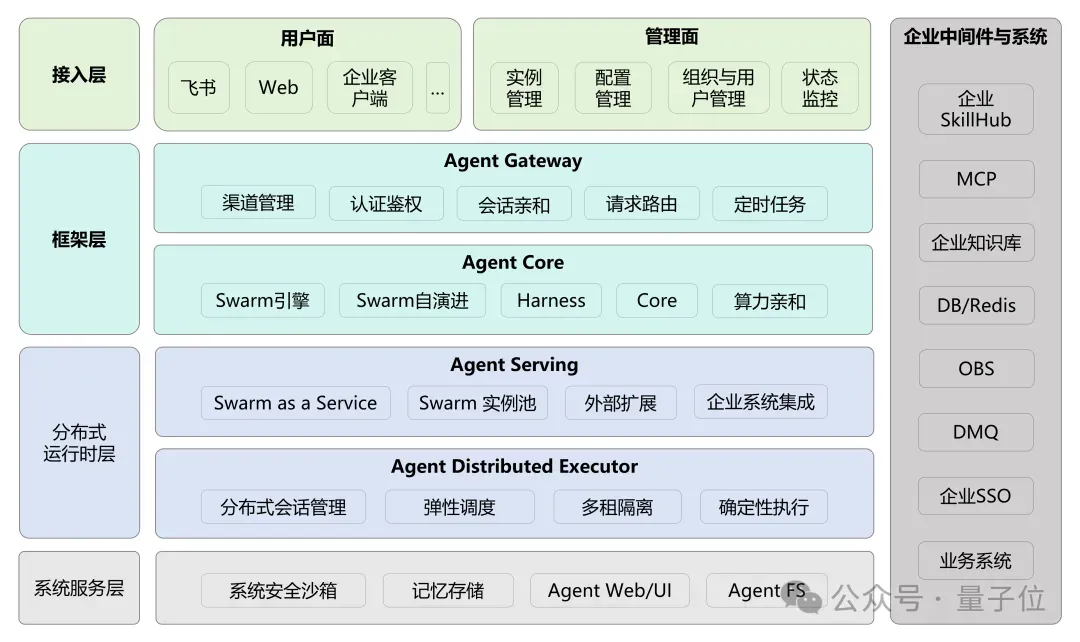
openJiuwen發佈業界首個企業級分佈式蜂群架構,聯合郵儲成功落地金融生產環境
< img id="wx_img" src="https://www.qbitai.com/wp-content/uploads/imgs/qbitai-logo-1.

螞蟻集團開源Avernet,讓人與智能體像組織一樣高效協作
**螞蟻集團開源Avernet:打造人與智能體高效協作的“組織級”基礎設施** **來源:量子位** **2026-08-07 11:08:51** 近日,螞蟻集團正式宣佈開源多智能體協作基礎設施Avernet,其社區版本已同步上線。作為業界首個聚焦於“組織級協作”的智能體基礎設施,Avernet的首個版本重點開放了智能體協作網絡能力,旨在支持不同智能體之間的發現、共識達成、跨團隊協作與治理,為人工智能從“單點智能”走向“系統智能”提供關鍵支撐。