NVIDIA Nemotron 3 Embed 在 RTEB 中整體排名第一,推動代理檢索發展
重點摘要
檢索在多步驟的代理工作流程中至關重要。NVIDIA Nemotron 3 Embed 在 RTEB(檢索任務評估基準)中榮獲整體第一名,顯著提升了代理檢索的能力。
Back to Articles NVIDIA Nemotron 3 Embed Ranks #1 Overall on RTEB, Advancing Agentic Retrieval Enterprise + Article Published July 16, 2026 Upvote - Yauhen Babakhin ybabakhin Follow nvidia Ronay Ak ronay-nv Follow nvidia Jiarui Cai jiaruic Follow nvidia Vinay Raman viraman Follow nvidia Radek Osmulski radekosmulski-nvidia Follow nvidia Jakub Zakrzewski jzakrzewski Follow nvidia Anmol Gupta anmolg-nvidia Follow nvidia Oliver Holworthy oliverholworthy Follow nvidia Sahel Sharifymoghaddam sahel-sh Follow nvidia Khang Pham KhangPhamML Follow nvidia James Rong hrong-nv Follow nvidia Steve Han steve-nvidia Follow nvidia Sean Sodha ssodha-nv Follow nvidia Isabel Hulseman ihulseman0220 Follow nvidia Bo Liu BoLiu Follow nvidia Retrieval is critical in multi-step agentic workflows where poor retrieval can cause agents to fetch irrelevant context, re-query, waste token budget, and carry noise into later reasoning steps.
Today, we are releasing NVIDIA Nemotron 3 Embed, a collection of open and commercially available embedding models designed to improve retrieval quality while giving developers practical deployment options for production-scale RAG, agentic retrieval, code retrieval, and agent memory.
The collection includes three open models that achieve state-of-the-art retrieval across the accuracy-efficiency curve, led by an 8B model that tops the RTEB leaderboard and efficient 1B variants built for production-scale deployment: Model Role Best for Nemotron-3-Embed-8B-BF16 Flagship Quality Anchor: The flagship embedding model, ranking #1 on RTEB.
Precision-critical retrieval and high-stakes enterprise RAG Nemotron-3-Embed-1B-BF16 High-Efficiency Standard: A high-efficiency model for production retrieval where latency and cost matter.
Cost- and latency-sensitive production serving Nemotron-3-Embed-1B-NVFP4 Hardware-Accelerated Variant: A Blackwell-optimized variant for high-throughput retrieval with a smaller memory footprint.Ultra-high-throughput and massive-scale infrastructure Table 1.
Nemotron 3 Embed Model Usability and Deployment Matrix.Figure 1.RTEB Multilingual Leaderboard screenshot (July 15, 2026) showing Nemotron-3-Embed-8B-BF16 ranked as #1.
Key Features Beyond the RTEB result, Nemotron 3 Embed introduces a production-ready feature set for enterprise retrieval deployments: Open Weights, Datasets, and Recipes: Gives teams control to inspect, tune, fine-tune, and deploy retrieval models on their own infrastructure.
32k Context Window: Supports retrieval over long documents, large code contexts, and multi-turn agent histories while reducing truncation.Multilingual & Code Retrieval: Supports retrieval across global enterprise data, technical documentation and multi-file code repositories.
NVIDIA NVFP4 Efficiency: Provides a Blackwell-optimized 4-bit deployment path for high-throughput retrieval with a smaller memory footprint.
Fine-Tuning and Distillation Recipes: NVIDIA NeMo AutoModel recipes support domain adaptation and model compression for teams adapting retrieval models to their own data.
Day-0 Ecosystem Integration: Available immediately on Hugging Face, deployable as NVIDIA NIM microservice, supported by vLLM, and accessible through leading AI Cloud and inference partners.
Evaluation: Retrieval Quality, Agentic Efficiency, and Deployment Tradeoffs We evaluate Nemotron 3 Embed across three dimensions: retrieval quality, downstream agentic efficiency, and deployment tradeoffs.
The 8B model establishes the model collection’s quality ceiling, while the 1B BF16 and NVFP4 variants bring the same retrieval-focused design to lower-cost and higher-throughput deployment settings.
RTEB Leadership and Strong Gains Across Retrieval Benchmarks We first evaluated the models on RTEB, where Nemotron-3-Embed-8B-BF16 ranks #1.We also tested these models across ViDoRe V3 Text, and MMTEB Retrieval and LongEmbed using average [email protected] 2.
Retrieval accuracy using average NDCG@10 across RTEB, ViDoRe V3 Text, MMTEB Retrieval and LongEmbed, comparing the Nemotron 3 Embed models with prior-generation Nemotron baselines.Nemotron-3-Embed-8B-BF16 ranks #1 on RTEB, scoring 78.5% on RTEB and 75.5% on MMTEB Retrieval.
Nemotron-3-Embed-1B-BF16 brings much of the 8B model’s retrieval quality into a smaller deployment footprint.It scores 72.4% on RTEB, reducing error rate by 27% over its 1B predecessor (llama-nemotron-embed-vl-1b-v2), and scores 71.0% on MMTEB Retrieval, reducing error rate by 28%.
Why Better Retrieval Matters for Agents To evaluate retrieval in an agentic setting, we use a search agent powered by Nemotron 3 Ultra and vary the embedding model used by the retrieval system.
Better retrieval can return relevant evidence earlier, helping the agent avoid repeated searches, unnecessary reasoning turns, and extra context inspection.We compare average retrieval accuracy with estimated downstream agentic token cost per query across ViDoRe V3, BRIGHT, and BrowseComp-Plus.
Figure 3.Average retrieval accuracy versus downstream agentic token cost per query across ViDoRe V3, BRIGHT, and BrowseComp-Plus.Evaluation note: The search agent uses Nemotron 3 Ultra.Downstream token cost is estimated from Nemotron 3 Ultra input/output token counts using the GPT-5.
5 pricing formula.Figure 3 shows that stronger retrieval reduces downstream agentic token cost.More accurate retrievers return relevant evidence earlier, which helps agents complete tasks with fewer repeated searches and fewer reasoning turns.
In these evaluations, the Nemotron 3 Embed models improve the agentic retrieval frontier, with the 8B model delivering both the highest average retrieval accuracy and the lowest estimated downstream token cost across ViDoRe V3, BRIGHT, and BrowseComp-Plus.
Scaling Retrieval with NVFP4 on Blackwell For high-throughput deployments, teams often choose smaller embedding models to meet latency and cost targets.
Nemotron-3-Embed-1B-NVFP4 is designed to narrow the gap between serving efficiency and retrieval quality by using native NVFP4 acceleration on NVIDIA Blackwell architectures.
The model quantizes the weights and activations of linear layers to NVFP4 for efficient inference, and uses Quantization-Aware Distillation (QAD) to help recover accuracy for long input sequences.Figure 4.
ViDoRe V3 retrieval accuracy versus serving efficiency, comparing Nemotron-3-Embed-1B-NVFP4 with selected smaller open embedding baselines, including Qwen3-Embedding-0.6B and EmbeddingGemma-300M.
Serving Efficiency: NVFP4 on Blackwell delivers up to 2x higher throughput than BF16 for high-throughput, low-latency retrieval serving.Accuracy retention: The NVFP4 variant retains 99%+ of BF16 retrieval accuracy while reducing memory footprint.
Day 0 Performant NIM For production-scale retrieval systems, the serving stack also needs to preserve that efficiency under real request loads, across different input sequence lengths and hardware targets.
To make Nemotron 3 Embed performant at enterprise scale today, we are also releasing an optimized NVIDIA NIM microservice for the 1B model.
As shown in Figure 5, the Rust-based Nemotron 3 Embed NIM matches or outperforms the vLLM checkpoint on NVIDIA GB200 and RTX PRO 6000 GPUs across ISLs of 256 & 1024.Figure 5.Nemotron 3 Embed NIM serving performance compared with the vLLM checkpoint on NVIDIA GB200 and RTX PRO 6000 GPUs.
How We Built the Nemotron 3 Embed Models Nemotron-3-Embed-8B-BF16 adapts the Ministral-3-8B-Instruct-2512 backbone by converting its causal decoder into a bidirectional encoder for full-sequence retrieval.
The model is trained with contrastive pre-training on a blend of web-sourced and synthetic text pairs, then fine-tuned on curated multilingual retrieval datasets across domains such as legal, finance, medical, business, and education.
This 8B model serves as the flagship embedding model, while earlier 8B teacher checkpoints from the same development line were used to distill the efficient 1B variants.Scaling Down to 1B The 1B model is not a small retriever trained from scratch.
We first applied the bidirectional adaptation recipe to the Ministral-3-3B-Instruct-2512 backbone to establish a 3B retriever base, then compressed it through two-rounds of structured pruning and distillation.
First, the 3B parent model was compressed to a 2B intermediate footprint using NVIDIA ModelOpt’s mcore_minitron Neural Architecture Search engine.
The NAS pipeline searched across hidden width, FFN size, attention heads, and depth under a strict parameter budget to identify an efficient architecture for retrieval workloads.The resulting 2B intermediate model was then distilled from an 8B teacher checkpoint to recover ranking accuracy.
We used a combined cosine distance loss and mean squared error loss on a multilingual, in-domain retrieval data blend to align the student’s embeddings with the teacher.Figure 6.The pruning and distillation pipeline compresses the retriever from a 3B base to the final 1B production model.
This same sequence, ModelOpt structured pruning followed by 8B teacher distillation, was repeated a second time to compress the 2B intermediate model down to the final 1.14B embedding model.
Final training used a progressive two-stage context-scaling schedule: Stage 1: Focused on broad multilingual alignment at 1024-token context length to reconstruct the core retrieval behavior of the parent model.
Stage 2: Expanded context length to 4096 tokens and added long-context synthetic and reasoning datasets, helping the 1B model retain discriminative recall across longer inputs.
The following table summarizes the core technical specifications and deployment targets for the Nemotron 3 Embed models: Model Size Emb Dim Context Window Pooling Input Prefix Target Hardware Nemotron-3-Embed-8B-BF16 8.
0B 4096 32k Mean query: / document: General GPU Inference Nemotron-3-Embed-1B-BF16 1.14B 2048 32k Mean query: / document: Low-latency CPU/GPU Nemotron-3-Embed-1B-NVFP4 1.14B 2048 32k Mean query: / document: NVIDIA Blackwell/GB200 Table 2.
Architectural specifications and core inference configurations for the Nemotron 3 Embed models.
Enterprise Partner Evaluations Enterprise ISVs, AI-native companies, and memory providers are already evaluating Nemotron 3 Embed across agentic retrieval, agent memory, code retrieval, and production inference workflows."Context is the key to agentic accuracy.
Our Context Intelligence Graph uses embeddings and semantic similarity to deliver the most relevant enterprise context to agents like EnterpriseClaw, which we launched with NVIDIA in May.
Early results from NVIDIA’s new Nemotron 3 Embed models are promising, particularly for question answering, where they show improvements over our current model.We’re excited about their potential to further improve the accuracy and reliability of our enterprise agents.
" - Adi Kuruganti, Chief AI and Development Officer at Automation Anywhere "Our initial evaluation of the NVIDIA Nemotron 3 Embed models shows strong retrieval performance for our agentic retrieval use cases.
The availability of both 1B and 8B variants gives teams the flexibility to balance quality, latency, and deployment requirements across different environments.We're excited to continue evaluating the models and exploring how they can support high-performance retrieval for production AI applications.
" - Mani Gill, Senior Vice President of Product Management at Boomi IBM has seen promising early results evaluating the new NVIDIA Nemotron Embed model in a proof-of-concept built on watsonx.data.
Mem0 is evaluating NVIDIA Nemotron 3 Embed for its AI agent memory solution, where embeddings help retrieve relevant memories, link related context, and track relationships across an agent’s interactions.
Palantir is collaborating with NVIDIA to evaluate the deployment of Nemotron 3 Embed for end customers conducting edge retrieval workloads, building on the prior work making NVIDIA embedding models available in AIP's Model Catalog.ServiceNo
Related
相關文章

當 human in the loop 變成“閉著眼睛點確認”,企業Agent 安全還能靠誰?
專家指出,AI Agent 從內容安全轉向行為安全,提示詞注入、工具濫用與過度授權成為主要風險。企業應建立可視、可管、可追溯的安全基線,並對工具權限進行最小化與臨時化管理,避免 human in the loop 淪為形式。安全防護需從靜態入口轉向動態行為約束,以因應 Agent 自主執行帶來的全新挑戰。

開源Agent框架刷爆ARC-AGI-3,「自我改進」的RLM harness引爭議
一套開源Agent框架在ARC-AGI-3基準測試中創下超過85%的正確率,大幅領先其他解決方案,其核心是名為「RLM harness」的自我改進機制。然而,該方法引發學術爭議,部分研究者批評它透過反覆試錯「鑽漏洞」,不符合ARC-AGI評測一次性推理的精神。這場討論促使AI社群重新審視評測標準,並可能影響未來ARC-AGI版本的設計方向。
騰訊是在“賽馬”,還是在打造 “Agent工廠”?
騰訊內部正在探討其發展策略究竟是「賽馬」機制還是打造「Agent工廠」。相關討論聚焦於公司如何平衡內部競爭與統一平台建設。目前站內已移除相關混雜文字,保留原始主題供讀者參考。
ChinaJoy 2026 AI遊戲規模化落地,邊緣雲與API安全重構產業底層邏輯
2026年ChinaJoy展館,“與AI同遊”的主題隨處可見。行業調查顯示,僅有21%的企業擁有完整的API資產清單,大量後臺AI接口仍在無人監控的狀態下裸奔。合規與安全也同步下沉。算力下沉還不夠,API安全必須同步前移邊緣雲解決了體驗問題,但AI交互入口的安全,同樣需要前置到邊緣。算力與安全,缺一不可Akamai的判斷很明確:遊戲AI轉型不能割裂算力與安全。這也是遊戲廠商規模化落地AI智能體、構建AI原生遊戲的標準化底層方案。
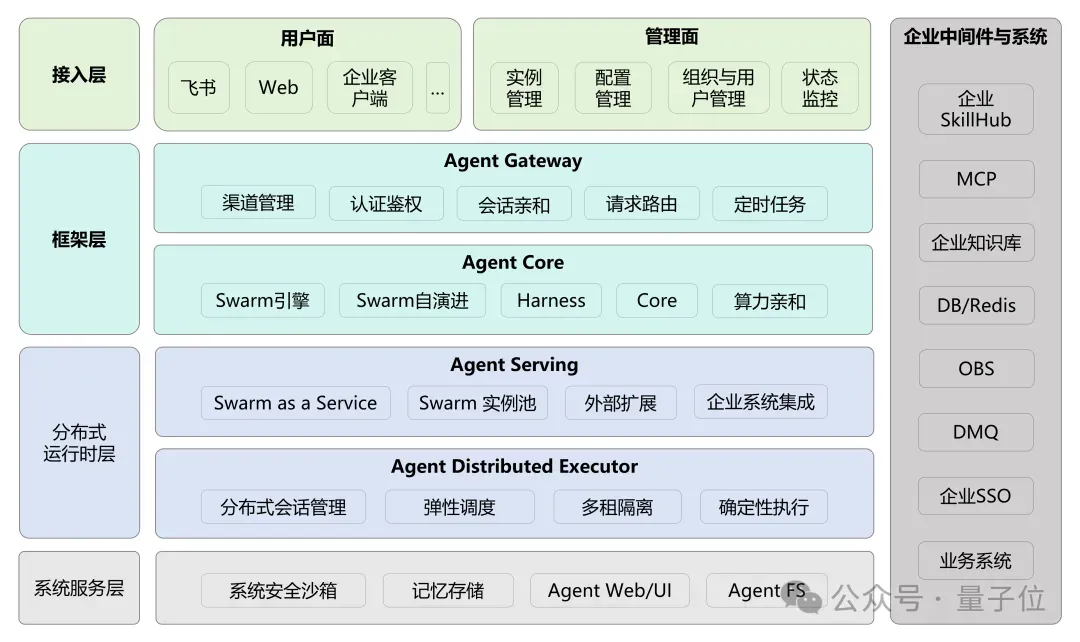
openJiuwen發佈業界首個企業級分佈式蜂群架構,聯合郵儲成功落地金融生產環境
< img id="wx_img" src="https://www.qbitai.com/wp-content/uploads/imgs/qbitai-logo-1.

螞蟻集團開源Avernet,讓人與智能體像組織一樣高效協作
**螞蟻集團開源Avernet:打造人與智能體高效協作的“組織級”基礎設施** **來源:量子位** **2026-08-07 11:08:51** 近日,螞蟻集團正式宣佈開源多智能體協作基礎設施Avernet,其社區版本已同步上線。作為業界首個聚焦於“組織級協作”的智能體基礎設施,Avernet的首個版本重點開放了智能體協作網絡能力,旨在支持不同智能體之間的發現、共識達成、跨團隊協作與治理,為人工智能從“單點智能”走向“系統智能”提供關鍵支撐。