Foundry 受管計算上的 Hugging Face 模型
重點摘要
在 Microsoft Build 2026 上,我們宣佈了 Foundry 受管計算與 Foundry 上的 Hugging Face 模型——一個來自 Hugging Face 生態系統的開放權重模型精選目錄,每週更新,可一鍵部署至 Foundry 受管計算。模型權重預先部署於 Azure,運行環境由 Microsoft 建置與掃描,且目錄中的每個模型均享有與 Foundry 上其他模型相同的企業級安全性、治理、可觀測性與計費機制。平臺:Microsoft Foundry 與受管計算是用於建置與營運代理式 AI 應用程式的平臺。
Back to Articles Hugging Face Models on Foundry Managed Compute Enterprise Article Published July 7, 2026 Upvote - Manoj Bableshwar manojsb Follow microsoft Osi ositanachi Follow microsoft At Microsoft Build 2026, we announced Foundry Managed Compute and Hugging Face models on Foundry — a curated catalog of open-weight models from the Hugging Face ecosystem, refreshed weekly, deployable in one click onto Foundry Managed Compute.
Weights are pre-staged in Azure, runtimes are built and scanned by Microsoft, and every model in the Collection ships with the same enterprise security, governance, observability, and billing that applies to every other model on Foundry.
The Platform: Microsoft Foundry and Managed Compute Microsoft Foundry is a platform for building and operating agentic AI applications.
Foundry starts with the widest model selection on any cloud — models from Microsoft, OpenAI, Anthropic, Meta, Mistral, DeepSeek, Hugging Face, and others, spanning frontier, open-source, and custom weights — all accessible through a single endpoint and a single set of SDKs in Python, C#, JavaScript, and Java.
On top of those models sits the Foundry Agent Service: multi-agent orchestration with built-in memory, knowledge grounding through Foundry IQ, and a catalog of connectable tools via agentic protocols, so agents can work with enterprise data.
Once agents are running, Foundry provides end-to-end tracing, real-time monitoring, continuous evaluations, and a prompt optimizer that improves agent behavior based on eval results — observability and quality loops that are part of the platform.
Alongside that, developers get access to: Content safety filters Task-adherence guardrails An AI Red Teaming Agent for adversarial testing Unified RBAC Private networking Azure Policy integration directly within the platform Alongside pay-per-token (lowest-friction path to get started) and provisioned throughput (predictable, high-performance production workloads on frontier models), Foundry Managed Compute is the third deployment option in Foundry: a managed GPU platform-as-a-service for open-source and custom models.
You deploy a model instance described by the things that matter to your workload — parameter count, context length, and whether you want to optimize for latency or throughput — and Foundry handles the GPU topology underneath, whether the instance lands on one accelerator or several, so you think and plan in model terms.
Microsoft takes care of the machine: container updates, runtime upgrades, and security patches happen automatically on the supported runtimes — vLLM, SGLang, TensorRT-LLM, NIM, TEI, llama.cpp — without redeploying your model, while model configuration, deployment behavior, and routing stay with you.
That consistency carries through the developer surface — pay-per-token, provisioned throughput, and Managed Compute share: A single endpoint The same SDKs The same authentication The same observability A single bill Open-source models integrate with Foundry Agents the same way frontier models do, so you can mix model types in a single agent without a separate integration path.
Managed Compute offers: Global deployments — broadest capacity and best pricing Data Zone deployments — residency and sovereignty Same code, same workflow.Quota is aligned to accelerator families, so a plan built on the H100 family today carries forward as new hardware generations come online.
Why Hugging Face Hugging Face is the public square of open AI: 15 million builders, 400,000 organizations, and over 3 million open models published, with new frontier capabilities — agentic coding, video segmentation, speech, embeddings — landing weekly.
It's the GitHub of open models, where the community publishes weights, writes model cards, compares evaluations, and pulls models for experimentation.
Open models have closed the gap with proprietary models on benchmark after benchmark, and they unlock things proprietary endpoints can't: State-of-the-art is now open.Leading open-weight models are competitive with the top closed frontier models on the most widely used benchmarks.Deep customization.
Full weights make it possible to fine-tune, distill, quantize, and adapt with LoRA — tailoring models to your domain, your data, and your latency and cost targets.Your model, your hosting.
Weights run in your tenant on infrastructure you control, behind your inference endpoint, with your identity and network boundaries.Cost shaping.
Pay for accelerators by the hour, scale to zero when idle, and right-size GPUs to the specific model — useful for steady, high-volume, or latency-sensitive workloads where per-token pricing is harder to predict.Version control.
Pin a specific model version, evaluate it, deploy it, and move forward or roll back on your own release cadence.
The catch has always been the operational layer: discovery, license review, security screening, runtime selection, GPU sizing, image building, CVE patching, and standing the model up behind an enterprise-grade endpoint.Hugging Face, by itself, is not an enterprise serving platform.
Hugging Face models on Foundry is that operational layer, run by Microsoft.
Hugging Face Models on Foundry The Hugging Face Collection brings a curated subset of models directly into the Foundry Model Catalog: Refreshed weekly — trending models from the Hugging Face ecosystem are added continuously as the community publishes them.
Every modality — text, vision, audio, and multimodal: LLMs and VLMs for chat and agents, ASR and speech translation, embeddings, segmentation, image generation.
Safetensors only, no untrusted code — every model in the Collection is security-screened and ships in the SafeTensors weight format, with no trust_remote_code execution paths unless rigorously reviewed.
The right runtime for the model — vLLM and SGLang for LLMs, TensorRT-LLM and NIM where applicable, TEI for embeddings, llama.cpp for CPU — Foundry picks the engine that matches the model.
From your side, an open-weight model in the Hugging Face Collection looks and behaves like any other model in the Foundry Model Catalog, and every model in the Collection has been put through a multi-stage publishing pipeline before it ever shows up there.
The Curation Pipeline Hugging Face and Microsoft work together to bring the most popular open-weight models from the Hugging Face ecosystem to Microsoft Foundry — production-ready for enterprise environments — through a systematic curation process: Identify trending models in the Hugging Face ecosystem — based on community signals, partner requests, and customer demand — and select candidates for enterprise readiness.
Screen for compliance and security — model licenses are reviewed against Microsoft's enterprise distribution policy (with license metadata captured and preserved on the catalog model card), and repositories are inspected for trust_remote_code patterns and custom executable code; any model that would require executing third-party Python at load time is either remediated or excluded.
Build, scan, and publish runtimes — Microsoft builds inference container images on supported runtimes (vLLM, SGLang, TensorRT-LLM, NIM, TEI, llama.cpp), scans them for CVEs, and signs and publishes them to a Microsoft-managed container registry.
Upload weights to secure Azure storage — model weights are pulled from Hugging Face once, validated against the published model card, and stored in Microsoft-managed Azure storage in the regions where the model is served.
Validate and publish to the catalog — every model + runtime + accelerator combination is tested for API conformance (chat completions, embeddings, rerank, etc.
) and performance (latency, throughput, time-to-first-token, inter-token decode time), then the validated model — with its templates, runtime images, and weights — is published to the Foundry Model Catalog with a one-click deploy path onto Managed Compute.
Because weights are pre-staged in Azure storage and runtime images live in a Microsoft-managed registry, your deployments won't need outbound network access to Hugging Face Hub — you can deploy to production inside a private network.
Model Runtimes Hugging Face models on Foundry are powered by a versatile collection of community-built, open-source inference runtimes — each selected and tuned for Foundry Managed Compute, and matched to the model architectures it serves best.
Across all runtimes, the systematic curation process means new versions and patches land on Foundry quickly, and existing model deployments are upgraded automatically — without requiring you to redeploy.
vLLM — the default high-throughput serving engine for open large language models, tuned for production GPU workloads.
Because Hugging Face is a direct contributor to vLLM, any model in the Transformers library can run on vLLM out of the box — so when a new model lands on Hugging Face, it can be served on Foundry the same day, with no waiting on a custom integration.
SGLang — a serving engine for language and multi-modal models, with strong support for structured outputs (JSON, regex, grammar-constrained generation) that agentic and tool-using workloads depend on.
Hugging Face and the SGLang team have built a Transformers backend integration for SGLang, so any model in the Transformers library runs on SGLang out of the box — and reaches Foundry the same day it lands on Hugging Face.
Text Embeddings Inference (TEI) — the runtime for embedding, reranker, and sequence-classification models.Accelerator-specific images ship with kernels compiled for each GPU and CPU family Foundry supports, keeping the embedding hot path lean for RAG and semantic-search workloads.llama.
cpp — the CPU and small-GPU path for GGUF-quantized models.Useful for cost-optimized deployments, smaller models, and CPU-only regions, with the same OpenAI-compatible API as vLLM and SGLang.
TensorRT-LLM and NIM — used on NVIDIA hardware where NVIDIA's optimized kernels and Triton-based serving deliver meaningfully better latency or throughput for specific model families.
hf-serve — Hugging Face's own multi-model inference server, used for model architectures outside the LLM and embedding fast paths (vision, audio, segmentation, and other Transformers-native pipelines) so the Collection can cover every modality with a consistent serving layer.
Deploying and Scoring an Open-Weight Model The Hugging Face Collection in the Foundry Model Catalog is where you start, and deployment is five steps: Browse the catalog and pick a model — the deploy wizard also surfaces the model id, deployment template id, and acceleratorType you'll need if you're scripting the deploy via SDK or REST.
Choose a deployment template — latency- vs throughput-optimized, accelerator family, context length, quantization.Configure instance count — scale throughput by adding model instances.Deploy — from the portal, CLI, SDK, or REST.Score via the unified Foundry endpoint with the SDK you already use.
Deployment Templates A deployment template is the unit of choice in step 2: a named, versioned asset that pins the runtime, the accelerator family and count, the context length, and the runtime-specific tuning needed to serve the model well — so picking a template is the only knob you turn for "how do I want this model to run.
" qwen3-32b, for example, ships with four templates the deploy wizard exposes side by side: Template Runtime Accelerator Context qwen–qwen3-32b–40k-nvidia-a100 vLLM 1 × A100 80 GB 40K qwen–qwen3-32b–40k-nvidia-h100 vLLM 1 × H100 80 GB 40K qwen–qwen3-32b–128k-nvidia-2xa100 vLLM 2 × A100 80 GB 128K qwen–qwen3-32b–128k-nvidia-2xh100 vLLM 2 × H100 80 GB 128K Each template arrives pre-tuned for the model — runtime settings, tool-call and reasoning parsers, scoring path, health probes, request concurrency, and any model-specific context-extension settings are all set by Microsoft, with any trade-offs called out inline in the template description.
When you script the deploy, yo
Related
相關文章

當 human in the loop 變成“閉著眼睛點確認”,企業Agent 安全還能靠誰?
專家指出,AI Agent 從內容安全轉向行為安全,提示詞注入、工具濫用與過度授權成為主要風險。企業應建立可視、可管、可追溯的安全基線,並對工具權限進行最小化與臨時化管理,避免 human in the loop 淪為形式。安全防護需從靜態入口轉向動態行為約束,以因應 Agent 自主執行帶來的全新挑戰。

開源Agent框架刷爆ARC-AGI-3,「自我改進」的RLM harness引爭議
一套開源Agent框架在ARC-AGI-3基準測試中創下超過85%的正確率,大幅領先其他解決方案,其核心是名為「RLM harness」的自我改進機制。然而,該方法引發學術爭議,部分研究者批評它透過反覆試錯「鑽漏洞」,不符合ARC-AGI評測一次性推理的精神。這場討論促使AI社群重新審視評測標準,並可能影響未來ARC-AGI版本的設計方向。
騰訊是在“賽馬”,還是在打造 “Agent工廠”?
騰訊內部正在探討其發展策略究竟是「賽馬」機制還是打造「Agent工廠」。相關討論聚焦於公司如何平衡內部競爭與統一平台建設。目前站內已移除相關混雜文字,保留原始主題供讀者參考。
ChinaJoy 2026 AI遊戲規模化落地,邊緣雲與API安全重構產業底層邏輯
2026年ChinaJoy展館,“與AI同遊”的主題隨處可見。行業調查顯示,僅有21%的企業擁有完整的API資產清單,大量後臺AI接口仍在無人監控的狀態下裸奔。合規與安全也同步下沉。算力下沉還不夠,API安全必須同步前移邊緣雲解決了體驗問題,但AI交互入口的安全,同樣需要前置到邊緣。算力與安全,缺一不可Akamai的判斷很明確:遊戲AI轉型不能割裂算力與安全。這也是遊戲廠商規模化落地AI智能體、構建AI原生遊戲的標準化底層方案。
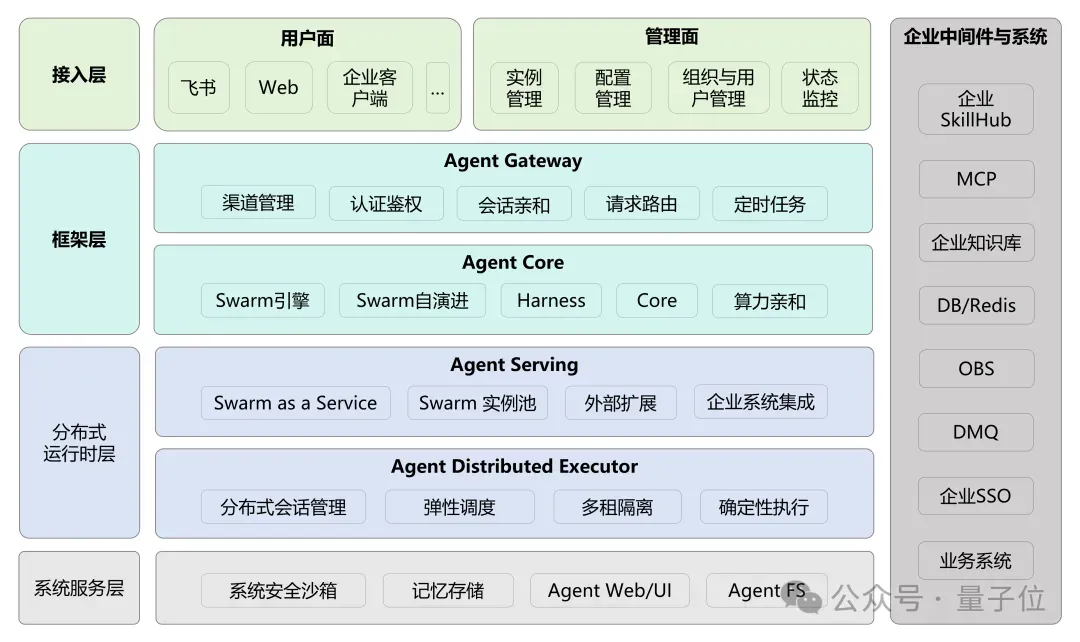
openJiuwen發佈業界首個企業級分佈式蜂群架構,聯合郵儲成功落地金融生產環境
< img id="wx_img" src="https://www.qbitai.com/wp-content/uploads/imgs/qbitai-logo-1.

螞蟻集團開源Avernet,讓人與智能體像組織一樣高效協作
**螞蟻集團開源Avernet:打造人與智能體高效協作的“組織級”基礎設施** **來源:量子位** **2026-08-07 11:08:51** 近日,螞蟻集團正式宣佈開源多智能體協作基礎設施Avernet,其社區版本已同步上線。作為業界首個聚焦於“組織級協作”的智能體基礎設施,Avernet的首個版本重點開放了智能體協作網絡能力,旨在支持不同智能體之間的發現、共識達成、跨團隊協作與治理,為人工智能從“單點智能”走向“系統智能”提供關鍵支撐。