Genesis AI 推出 Nyx、Quadrants 與 Genesis World 1.0 物理平臺,助力可擴展機器人基礎模型評估
重點摘要
Genesis AI 發布了 Genesis World 1.0 平臺,該平臺由四個組件構成:Genesis World 物理引擎、Nyx(即時路徑追蹤渲染器)、Quadrants(Python 到 GPU 編譯器)以及一個模擬介面。其目標是透過基於模擬的評估來加速機器人基礎模型的開發。機器人模型的開發面臨兩大瓶頸:數據與迭代速度。目前該領域高度聚焦於數據問題,但 Genesis AI 認為,較少被討論且更為緩慢的瓶頸其實是模型開發週期本身——具體而言,就是團隊評估候選策略與比較模型檢查點的速度。這個平臺解決了什麼問題?在 Genesis 中,一次典型的策略評估涵蓋數百項任務,每項任務包含數百個回合。若在真實世界中進行此類評估,所需的時間將遠超過模擬環境。
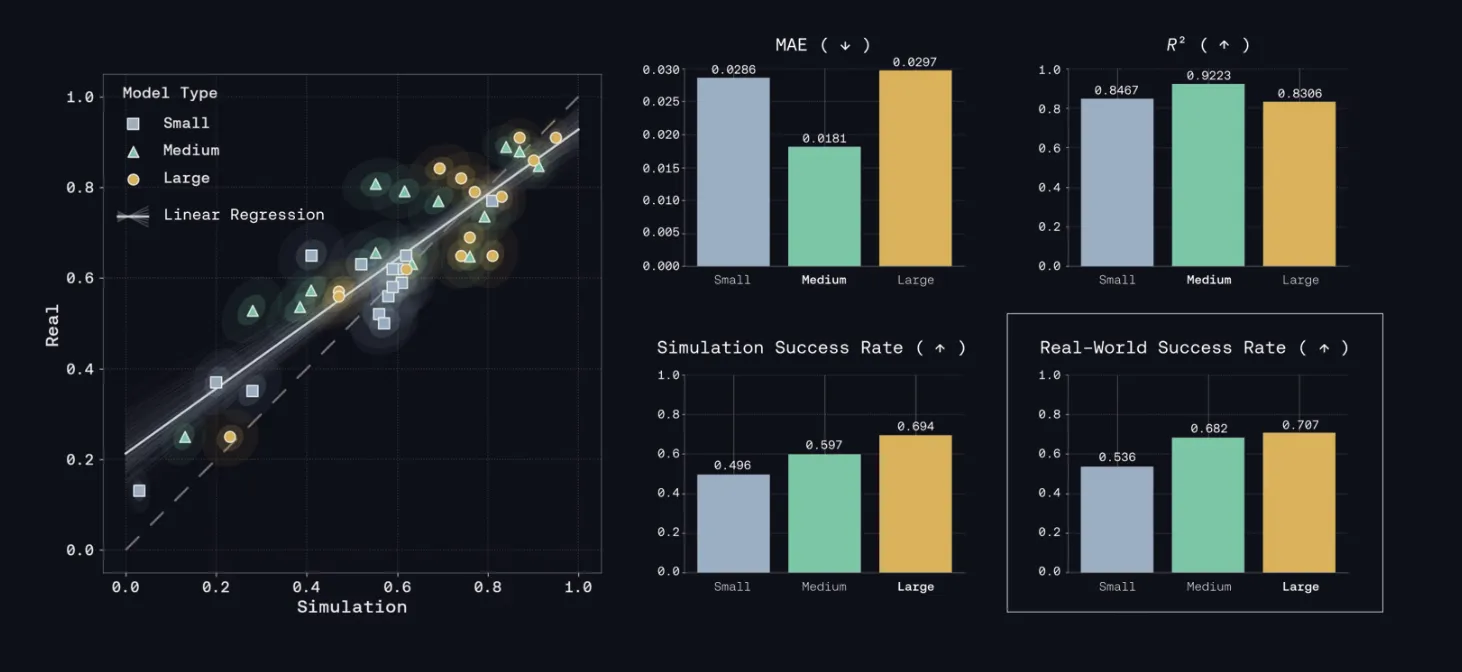
Genesis AI released Genesis World 1.0. The platform consists of four components: the Genesis World physics engine, Nyx (a real-time path-traced renderer), Quadrants (a Python-to-GPU compiler), and a simulation interface. It is designed to accelerate robotics foundation model development through simulation-based evaluation. Robotics model development has two bottlenecks: data and iteration speed. The field has focused heavily on data. Genesis AI argues the slower, less-discussed bottleneck is the model development cycle itself — specifically, how fast teams can evaluate candidate policies and compare model checkpoints. What Problem Does This Solve? A typical policy evaluation at Genesis spans hundreds of tasks with hundreds of episodes each. Running that in the real world requires more than 200 hours of continuous robot operation with one operator and one robot station — for a single evaluation pass. Statistically meaningful comparisons across checkpoints require many such passes. Genesis World 1.0 runs the same evaluation in under 0.5 hours, with no human or hardware in the loop and bit-exact result consistency across runs. That is roughly two orders of magnitude faster than real-world evaluation. The research team deliberately chose to prioritize evaluation before using simulation for training data generation. Their reasoning: if training and evaluation share the same simulated distribution, a performance improvement could reflect a tighter fit to simulator dynamics rather than a genuinely better model. Keeping the two pipelines separated produces a cleaner signal. The research team describes this evaluation approach as zero-shot real-to-sim: policies evaluated in simulation are trained exclusively on real-world data. No simulated data enters pretraining. Sim-to-Real Correlation Results Genesis research team reports a Pearson correlation of 0.8996 (95% CI: [0.7439, 0.9314]) between simulation and on-hardware rollouts. The evaluation covered three model variants (Small, Medium, Large) across 14 tasks with 200 episodes per task. The research team ran 1,000,000 bootstrap iterations to estimate confidence intervals. The Mean Maximum Rank Violation (MMRV) — a metric proposed in SimplerEnv — was 0.0166 (95% CI: [0.0102, 0.0474]). A low MMRV means the simulator preserves the relative performance ranking of different models. To diagnose where sim-to-real divergence comes from, Genesis team built a real-time side-by-side rig. It runs the simulator and physical robot in parallel from the same initialization. Observations — camera frames and proprioception — can come from the simulator, the robot, or a blend of both. Swapping one source at a time isolates whether divergence originates from physics, rendering, communication, or control. After this work, their reality gap is 45% smaller, measured by FID score on their dataset, than the next-best alternative simulator. https://www.genesis.ai/blog/the-role-of-simulation-in-scalable-robotics-genesis-world-10-and-the-path-forward?x_refresh=1 The Four Components of Genesis World 1.0 Nyx — Real-Time Path-Traced Rendering Nyx is a GPU-accelerated path tracer that plugs into Genesis World as a camera sensor. It is available as the gs-nyx-plugin Python package. Prebuilt wheels are available for x86-64 Linux (manylinux 2.34+) and Windows 10/11, and require an NVIDIA GPU with CUDA. Nyx targets noise-free 1080p frames in 4 ms or less on a high-end consumer GPU, with no baking and no ghosting. To reach that target, it uses a visibility buffer, a bindless GPU-driven architecture, MSAA, hardware ray tracing, hardware matrix cores, and video compression. Path tracing is the baseline: multi-bounce lighting, soft shadows, and indirect illumination are correct by construction. A physically grounded camera model sits on top. An HDRI pipeline lights scenes with measured radiance. Assets come from internal scanning and photogrammetry. 3D Gaussian splats extend coverage where mesh reconstruction is insufficient. Nyx is driven by batched physics rather than scene-by-scene execution. This allows thousands of parallel rollouts — each with its own scenario, lighting, and camera trajectory — to pass through a single unified rendering pipeline. Genesis World Physics — Unified Multi-Physics Engine The Genesis World physics platform is open source (Apache 2.0) and runs multi-physics in a single pipeline: articulated rigid bodies (MJCF/URDF/USD), FEM for elastic deformables and cloth, MPM for granular and elasto-plastic materials, SPH for fluids, and PBD for fast cloth and position-based liquids. Three interchangeable couplers are available behind the same scene API: a fast general-purpose coupler; a Drake-style Semi-Analytic Primal coupler with hydroelastic contact; and an Incremental Potential Contact (IPC) coupler for intersection-free contact in deformable scenes. Switching between couplers requires a one-line code change, with no changes to assets, sensors, or the policy interface. Genesis World 1.0 introduced two new solvers. The External Articulation Constraint (built on top of libuipc) embeds joint-space dynamics directly into IPC’s optimization, so joint-space forces and contact forces resolve simultaneously rather than staggered across separate solvers. The second is barrier-free elastodynamics, which replaces IPC’s logarithmic barrier with a custom augmented Lagrangian. Standard IPC’s barrier makes the Hessian ill-conditioned as contacts tighten. The augmented Lagrangian formulation avoids this, allowing every contact pair returned by continuous collision detection to enter the active set immediately. The research team reports up to 103× faster performance than traditional IPC in contact-heavy scenes, with intersection-free guarantees maintained. Additional improvements: new sensors (point-cloud tactile, temperature-grid, proximity), Implicit FEM with Newton + CG solver, and expanded asset support (URDF xacro, MuJoCo general actuators, compound/mimic joints, equality/weld constraints). Quadrants — Python-to-GPU Compiler Quadrants is a cross-platform compiler for GPU-accelerated physics simulation, developed by Genesis AI and released under Apache 2.0. Kernels are written in plain Python and JIT-compiled to NVIDIA CUDA, AMD ROCm, Apple Metal, Vulkan, and x86/ARM64 CPUs via LLVM. It was forked from Taichi in June 2025. The name references the Chinese philosophical saying that Taichi gives rise to the Four Forms (Quadrants). Key performance improvements over upstream Taichi: up to 4.6× faster runtime on Genesis manipulation and locomotion benchmarks. Warm-cache startup time for single_franka_envs.py dropped from 7.2 seconds to 0.3 seconds — a more than 10× speedup. Reverse-mode autodiff is now a first-class citizen on all backends, making differentiable simulation portable. Physics steps are recorded as single kernel graphs, removing per-step launch latency. Independent kernels run in parallel via streams. Dense linear algebra (Cholesky factorization, triangular solves) compiles to 16×16 tile-blocked code paths. A perf-dispatch layer benchmarks kernel variants on first call and caches the fastest choice per signature. Tensors share device memory with PyTorch via DLPack with zero-copy interop. Installation: Copy CodeCopiedUse a different Browserpip install quadrants Simulation Interface The fourth component is the simulation interface: tooling that connects the physics engine, renderer, and compiler into a usable system for downstream robotics applications. This includes a photogrammetry pipeline for creating digital twins, an automated pipeline for programmatic environment generation (scene layout, asset selection, task specification, and success metrics), and cross-embodiment environments spanning multiple robot configurations. Evaluation Framework Genesis structures evaluation as a taxonomy of orthogonal perturbation axes across approximately 10 dimensions, following the framework in “A Taxonomy for Evaluating Generalist Robot Mani
Related
相關文章

硬氪首發|moody前高管搭檔大疆骨幹入局陪伴機器人,錦秋領投,融資數千萬
這篇消息聚焦「硬氪首發|moody前高管搭檔大疆骨幹入局陪伴機器人,錦秋領投,融資數千萬」。原始導語提到:陪伴機器人的本質是“創造生命”。 從 AI 情報角度來看,這類內容值得關注其背後的技術進展、產品落地、產業競爭與後續市場影響。

全球首個人形機器人通用小腦 GPT 模型:銀河通用發佈 AstraBrain-WBC 0.5
“銀河通用機器人”官方公眾號今天(6 月 19 日)發佈博文,宣佈推出全球首個人形機器人通用小腦 GPT 基礎模型 AstraBrain-WBC 0.5,採用全球最大規模 2 萬小時人類動作數據訓練,8040 萬參數規模。
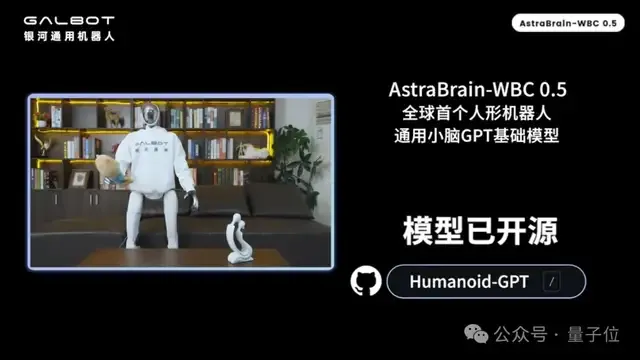
全球首個人形機器人通用小腦來了!全球最大規模2萬小時人類動作數據,實現零樣本泛化
這篇消息聚焦「全球首個人形機器人通用小腦來了!全球最大規模2萬小時人類動作數據,實現零樣本泛化」。原始導語提到:人形機器人正式邁入“GPT時代” 從 AI 情報角度來看,這類內容值得關注其背後的技術進展、產品落地、產業競爭與後續市場影響。
逮捕 0 個嫌犯、開出 0 張罰單,俄亥俄州警方解僱“機械戰警”
2025 年 7 月,警方把 DubBot 安排到當地一座停車樓巡邏,任務並不複雜。但警方發言人表示,DubBot 既沒有促成逮捕、刑事立案或罰單,也從未發現任何需要真人警察到場處理的事件。
擎倉機器人30天極速部署歐萊雅產線,輕量化VLA範式突破
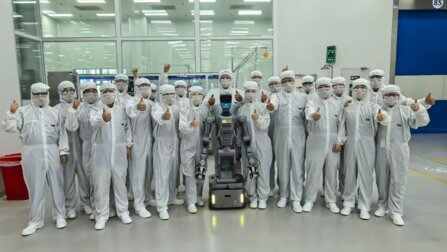
擎倉機器人成功部署歐萊雅全球戰略生產基地,不僅證明國產輕量化VLA具身智能產品完全能夠勝任國際高端製造的嚴苛標準,更標誌著中國企業率先實現輕量化VLA技術的規模化商業突破,成為中國具身智能產業從技術研發邁向規模化、全球化商用的重要里程碑。

上緯啟元佈局多城線下門店 小尺寸機器人Q1上市臨近
這篇消息聚焦「上緯啟元佈局多城線下門店 小尺寸機器人Q1上市臨近」。原始導語提到:不少品牌都開始重視線下門店的佈局 從 AI 情報角度來看,這類內容值得關注其背後的技術進展、產品落地、產業競爭與後續市場影響。