AI代理評估鴻溝:企業AI組織面臨的是現實校準問題,而非覆蓋率問題——多數仍照常部署至生產環境
重點摘要
在對157家企業的調查中,組織正賦予AI代理更多自主性,同時卻對用以管控該自主性的評估機制愈發缺乏信任。半數企業已曾將通過內部評估、卻在生產環境中導致客戶失誤的代理部署上線;僅二十分之一企業完全信任自動化評估;最常被指出的弱點是評估與實際結果不符。然而,仍有三分之二企業已允許或正積極規劃僅憑自動化評估結果(無人工介入)就將代理變更部署至生產環境。這導致「評估鴻溝」的出現——即企業賦予代理的自主程度,與其對理應能攔截失誤的測試機制的信任度之間的落差。本波VentureBeat Pulse研究深入探討此現象。
Across 157 enterprises, organizations are granting AI agents more autonomy while trusting the evaluations meant to gate that autonomy less.
Half have already shipped an agent that passed their internal evaluations and then failed a customer in production; only one in twenty fully trusts automated evaluation today; and the most-cited weakness is that evaluations do not align with real-world outcomes.
Yet two-thirds already allow, or are actively engineering toward, deploying agent changes to production on automated evaluation alone — with no human in the loop.
The result is an evaluation gap — the distance between how much autonomy enterprises are handing their agents and how far they trust the tests that are supposed to catch the failures.
This wave of VentureBeat Pulse Research examines how technical leaders measure agent performance: which reliability and evaluation platforms they use, how they select and trust them, what breaks in production, and how far they are willing to let agents run without a human in the loop.
The central finding is an evaluation gap — the distance between the autonomy enterprises are granting their agents and the trust they place in the evaluations meant to govern it.
Half of organizations (50%) have, in the past year, deployed an agent or LLM feature that passed their internal evaluations and then caused a customer-facing failure, and a quarter have seen it happen more than once.
Trust in the tests themselves is thin: only 5% say they fully trust automated evaluation today, and the single most-cited limitation is that evaluations align poorly with real-world outcomes (29%).Enterprises are discovering that a passing eval is not the same as a working agent.
What makes the gap consequential is the direction of travel.Two-thirds of organizations (66%) already permit fully automated, zero-human-in-the-loop deployment for low-risk agents (34%) or are actively engineering their pipelines to allow it within twelve months (33%).
At the same time, the evaluation stack that would have to earn that trust is fragmented and immature: the most common primary tools are the model providers’ native evals, tied with having no dedicated tooling at all (17% each); and only about a quarter of enterprises run real-time quality checks on live production traffic.
The autonomy is arriving faster than the assurance.MethodologyVentureBeat fielded this survey as part of its ongoing Pulse Research series, this survey — the Agentic Reliability & Evals tracker — focused on how technical leaders evaluate agent performance and reliability.
Responses are filtered to organizations with 100 or more employees (n=157), drawn from a single survey in June 2026; because this is one wave rather than a pooled multi-month sample, the report reads cross-sectionally and does not infer month-over-month trends.
Where questions were multiple-select, those shares can sum to more than 100%.By role the sample is senior and buyer-credible: 38% are final decision-makers for AI purchases and another 34% recommenders or influencers.
Product and program managers (15%), consultants and advisors (10%), directors of engineering/IT (8%), and CIOs/CTOs/CISOs (8%) lead the named titles, alongside a large “Other” function (37%).
By organization size the sample is mid-market-weighted: 100–499 (37%) and 500–2,499 (27%) employees lead, with 2,500–9,999 (20%), 10,000–49,999 (10%), and 50,000+ (6%) above them.
Technology/Software is the largest industry at 23%, followed by Retail/Consumer (15%), Healthcare/Life Sciences (12%), and Manufacturing (10%).
At 157 respondents the sample is large enough to read directionally but should be treated as a directional signal rather than a precise measurement; it is self-selected and is not a probability sample.
It skews toward the mid-market, so it is best read as the view from organizations actively standing up agent evaluation practices rather than from the largest operators.
Note: This survey was rebuilt for the June wave from the earlier “LLM observability and evaluations” survey; because the questions and sample differ, no comparisons are made to the April–May data.
Finding 1: A passing eval is not a working agentHalf have shipped an agent that passed evals, then failed a customerWe asked whether, in the past 12 months, organizations had deployed an agent or LLM feature that passed their internal evaluations but then caused a customer-facing failure.
Half of those that run evaluations had.This is the report’s defining number.
Half of organizations (50%) have shipped an AI feature that cleared their internal evaluations and then failed in front of a customer — an incorrect output, a broken workflow, or a quality incident — and a quarter have seen it happen more than once.
Only 36% report no such failure, and the remainder either run no pre-deployment evaluations (8%) or don’t track the root cause closely enough to know (6%).The failure is precise and expensive: the evaluation said the agent was ready, and it was not.
Everything that follows — how enterprises trust their evals, what they monitor, and how much autonomy they grant — is shaped by this experience.
Finding 2: Almost no one fully trusts automated evaluationThe top complaint: Evals don't match real-world outcomesWe asked which limitation most reduces trust in automated agent evaluations today.Only a sliver of enterprises had no complaint at all.
Trust in automated evaluation is scarce, and specific.Only 5% of organizations say they fully trust automated evaluation as it stands — meaning 95% name a limitation that holds them back.
The most common, at 29%, is the one that most directly explains Finding 1: evaluations align poorly with real-world outcomes, passing agents that later fail.
Bias or inconsistency (21%) and a lack of explainability (18%) follow — enterprises cannot always tell why an evaluation reached its verdict — and 17% cite data-leakage or privacy concerns in the evaluation process itself.
The tests meant to certify agents are not yet trusted to certify them, which is precisely why the autonomy trajectory in Finding 3 is so striking.
Finding 3: The autonomy ceiling is rising anywayTwo-thirds already allow, or are building toward, zero-human deploymentWe asked whether organizations would let an autonomous agent deploy a code or system change to production on automated evaluation results alone, with no human-in-the-loop validation.
The trajectory runs straight through the trust gap.Here is the paradox at the heart of the report.
Even though almost no one fully trusts automated evaluation (Finding 2), two-thirds of organizations (66%) either already allow zero-human-in-the-loop deployment for low-risk agents (34%) or are actively engineering their pipelines to permit it within a year (33%).
Only 22% rule it out for the foreseeable future.The direction is unambiguous: enterprises are moving to let evaluations gate production autonomously — removing the human check — at the same moment they say those evaluations don’t reliably match reality.
The autonomy ceiling is rising faster than the assurance beneath it, which is the mechanism by which the false-confidence failures of Finding 1 will scale rather than shrink.Notably, the autonomy bet is not just a small company phenomenon.
Splitting the sample by company size, larger enterprises are slightly further down the path toward zero human review than smaller companies (70% versus 64%) and slightly more likely to have shipped an evaluation-passing agent that then failed a customer (54% versus 48%).
The assumption that large, regulated organizations are holding the human in the loop longest is, in this sample, backwards.To be sure, these are directional figures, since the survey was not a huge sample — 57 respondents from companies with 2,500+ employees and 100 from companies smaller than that.
Finding 4: The evaluation stack is fragmented and provider-ledProvider-native evals lead — tied with no dedicated tool at allWe asked which agen
Related
相關文章

當 human in the loop 變成“閉著眼睛點確認”,企業Agent 安全還能靠誰?
專家指出,AI Agent 從內容安全轉向行為安全,提示詞注入、工具濫用與過度授權成為主要風險。企業應建立可視、可管、可追溯的安全基線,並對工具權限進行最小化與臨時化管理,避免 human in the loop 淪為形式。安全防護需從靜態入口轉向動態行為約束,以因應 Agent 自主執行帶來的全新挑戰。

開源Agent框架刷爆ARC-AGI-3,「自我改進」的RLM harness引爭議
一套開源Agent框架在ARC-AGI-3基準測試中創下超過85%的正確率,大幅領先其他解決方案,其核心是名為「RLM harness」的自我改進機制。然而,該方法引發學術爭議,部分研究者批評它透過反覆試錯「鑽漏洞」,不符合ARC-AGI評測一次性推理的精神。這場討論促使AI社群重新審視評測標準,並可能影響未來ARC-AGI版本的設計方向。

騰訊是在“賽馬”,還是在打造 “Agent工廠”?
騰訊內部正在探討其發展策略究竟是「賽馬」機制還是打造「Agent工廠」。相關討論聚焦於公司如何平衡內部競爭與統一平台建設。目前站內已移除相關混雜文字,保留原始主題供讀者參考。
ChinaJoy 2026 AI遊戲規模化落地,邊緣雲與API安全重構產業底層邏輯
2026年ChinaJoy展館,“與AI同遊”的主題隨處可見。行業調查顯示,僅有21%的企業擁有完整的API資產清單,大量後臺AI接口仍在無人監控的狀態下裸奔。合規與安全也同步下沉。算力下沉還不夠,API安全必須同步前移邊緣雲解決了體驗問題,但AI交互入口的安全,同樣需要前置到邊緣。算力與安全,缺一不可Akamai的判斷很明確:遊戲AI轉型不能割裂算力與安全。這也是遊戲廠商規模化落地AI智能體、構建AI原生遊戲的標準化底層方案。
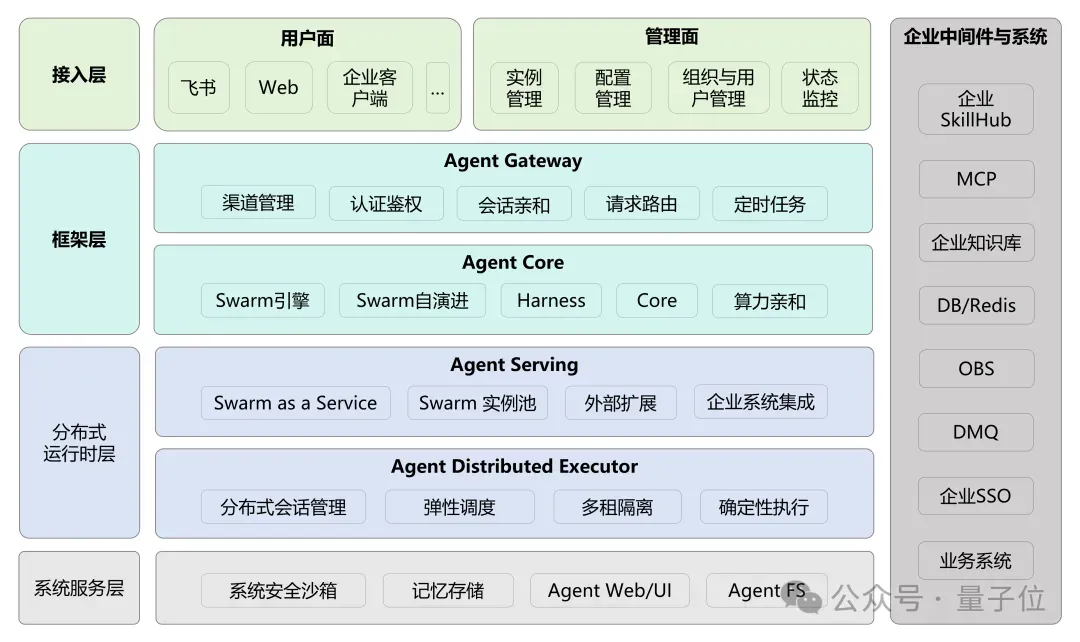
openJiuwen發佈業界首個企業級分佈式蜂群架構,聯合郵儲成功落地金融生產環境
< img id="wx_img" src="https://www.qbitai.com/wp-content/uploads/imgs/qbitai-logo-1.

螞蟻集團開源Avernet,讓人與智能體像組織一樣高效協作
**螞蟻集團開源Avernet:打造人與智能體高效協作的“組織級”基礎設施** **來源:量子位** **2026-08-07 11:08:51** 近日,螞蟻集團正式宣佈開源多智能體協作基礎設施Avernet,其社區版本已同步上線。作為業界首個聚焦於“組織級協作”的智能體基礎設施,Avernet的首個版本重點開放了智能體協作網絡能力,旨在支持不同智能體之間的發現、共識達成、跨團隊協作與治理,為人工智能從“單點智能”走向“系統智能”提供關鍵支撐。