Google AI 發布 DiffusionGemma:26B 參數 MoE 開放模型,採用文本擴散技術,生成速度提升 4 倍
重點摘要
Google AI 團隊(含 Google DeepMind 研究人員)近日發布 DiffusionGemma,這是一款專為文字生成設計的實驗性開放模型。有別於標準的自迴歸解碼方式,本模型採用文本擴散技術,並以寬鬆的 Apache 2.0 授權釋出。Google 將其定位給探索速度優先、互動式本地工作流程的開發者與研究人員,應用場景包括行內編輯、快速迭代,以及生成非線性文字結構。目前多數語言模型採用自迴歸方式,從左到右逐個產生 token,每個新 token 依賴於前一個 token。DiffusionGemma 則不同:它能同時並行生成整段文字。在專用 GPU 上,生成速度可提升高達 4 倍。
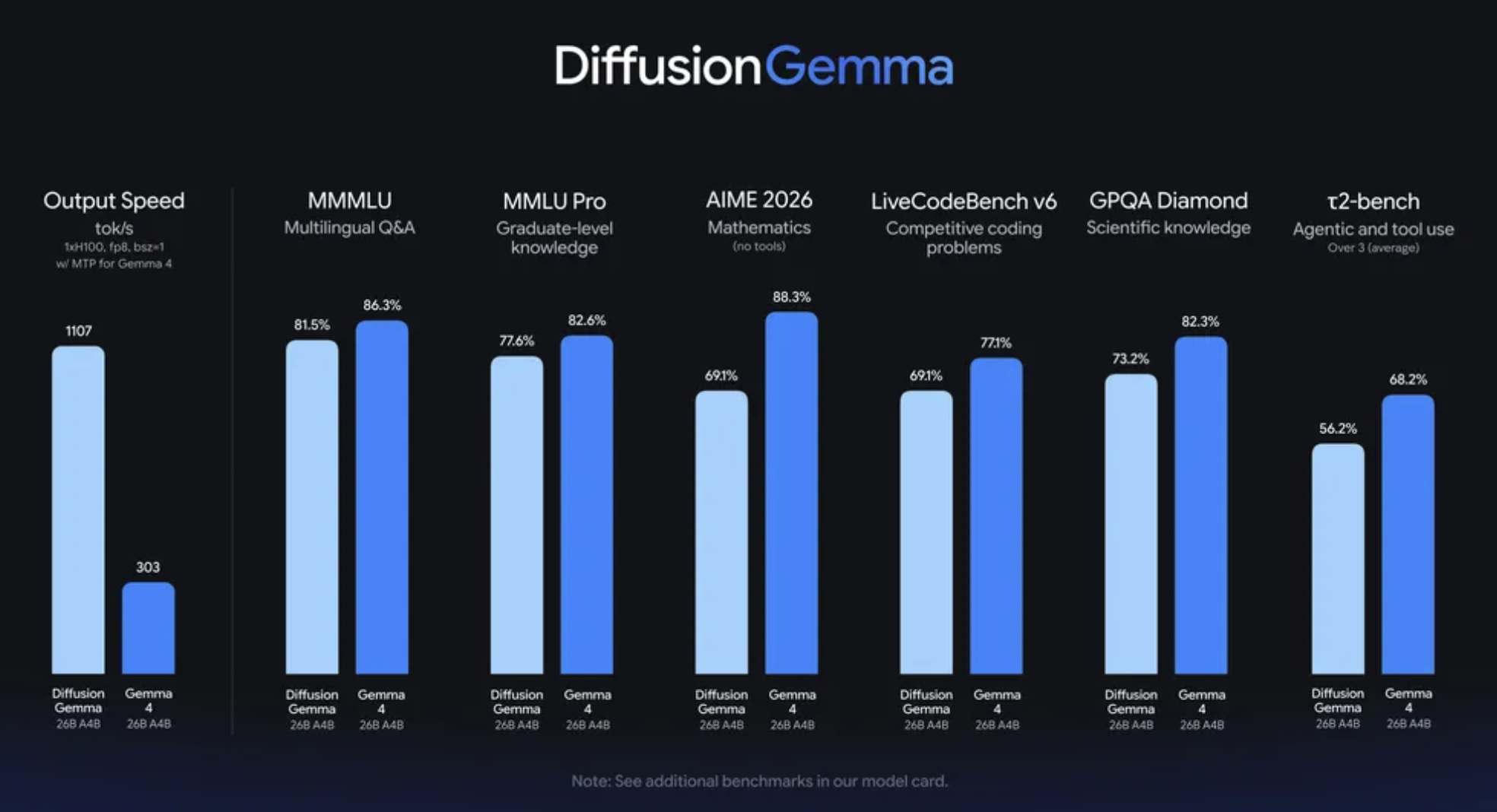
Google AI team including the Google DeepMind researchers have just released DiffusionGemma, an experimental open model for text generation. It uses text diffusion instead of standard autoregressive decoding. The model ships under a permissive Apache 2.0 license. Google positions it for devs and researchers exploring speed-critical, interactive local workflows. Examples include in-line editing, rapid iteration, and generating non-linear text structures. Most language models in use today are autoregressive. They generate one token at a time, left to right. Each new token depends on the token before it. DiffusionGemma works differently. It generates entire blocks of text simultaneously, in parallel. On dedicated GPUs, this delivers up to 4x faster generation. What is DiffusionGemma DiffusionGemma is a 26B Mixture of Experts (MoE) model. It activates only 3.8B parameters during inference. It is built on the Gemma 4 backbone, specifically the 26B-A4B architecture. Google integrated a diffusion head onto that base. The model is multimodal. It processes interleaved text, image, and video inputs. It generates text outputs from those inputs. The context window is 256K tokens, and it supports 140+ languages. Quantized, the model fits within 18GB of VRAM. That places it inside high-end consumer GPU limits. On a single NVIDIA H100, it reaches 1000+ tokens per second. On an NVIDIA GeForce RTX 5090, it reaches 700+ tokens per second. Google is very direct about the trade-off. DiffusionGemma prioritizes speed and parallel layout generation. Its overall output quality is lower than standard Gemma 4. For maximum quality production work, Google still recommends autoregressive Gemma 4. How Text Diffusion Works Text diffusion borrows its core idea from AI image generators. Those models start with visual static and refine it iteratively. DiffusionGemma applies the same pattern to text generation. The process runs in three conceptual stages. First, the model starts with a canvas of random placeholder tokens. Second, it makes multiple passes over that canvas. It locks in high-confidence tokens and uses them as context. Third, the text converges into the final output. Google calls the core mechanism Uniform State Diffusion. Highly confident tokens help resolve adjacent positions during denoising. The full sequence then snaps into focus over several passes. In practice, the model denoises a 256-token canvas in parallel. It finalizes roughly 15-20 tokens per forward pass. That parallelism is what drives the throughput gains. The model uses bidirectional attention during denoising. Every token on the canvas can attend to every other token. This is a sharp break from autoregressive models. Those models can only look backward at prior tokens. That bidirectional context enables real-time self-correction. If a token’s confidence drops, the sampler can re-noise it. The model then replaces that token on a later pass. Autoregressive models cannot do this, since they commit each token once. The Architecture The technical advancement here is hardware utilization. For local GPU inference, the main bottleneck is memory bandwidth. Autoregressive models repeatedly load weights from memory per token. During single-user serving, the GPU spends most time waiting. DiffusionGemma shifts the bottleneck from memory bandwidth to compute. It drafts and refines a 256-token canvas in parallel. This gives idle tensor cores a large parallel workload. The model alternates two attention modes during inference. Prefill uses causal attention to ingest the prompt and write the KV cache. Denoising uses bidirectional attention to refine the canvas. For longer outputs, DiffusionGemma uses Block Autoregressive Diffusion. Once a 256-token block is fully denoised, it commits to the KV cache. The model then starts a fresh canvas conditioned on prior history. This pairs parallel block speed with sequential autoregressive stability. The architecture shares the same backbone as Gemma 4 26B A4B. Developers mainly need to implement a denoising step. That makes integration into existing serving frameworks simpler. A clear example is the Sudoku showcase from Google’s developer guide. Autoregressive models struggle with strict, multivariable constrained puzzles. The base DiffusionGemma model solves roughly 0% of Sudoku puzzles. After a simple JAX supervised fine-tuning recipe, correctness rises to 80%. The fine-tuned model also stops earlier, cutting inference steps. Interactive Demo: How DiffusionGemma Decodes in Parallel The interactive visualizer below illustrates how DiffusionGemma decodes text, contrasted with a standard autoregressive model. Toggle between the two modes and press Run. In Autoregressive mode, tokens fill in one at a time, strictly left to right, taking one forward pass per token — the way most LLMs generate today. In Diffusion mode, the model starts from a canvas of masked placeholder tokens and resolves many of them in parallel each pass, in no fixed order, converging in far fewer passes. The animation also shows a brief re-noise step, where a low-confidence token is reset and refined again — a stand-in for the real model’s self-correction, which autoregressive decoding cannot do once a token is committed. Note this is a conceptual animation, not live model output: the real DiffusionGemma resolves a 256-token canvas and finalizes roughly 15–20 tokens per forward pass. #mtp-dg-demo *{box-sizing:border-box!important;margin:0!important;padding:0!important} #mtp-dg-demo hr,#mtp-dg-demo p:empty,#mtp-dg-demo del,#mtp-dg-demo s{display:none!important} #mtp-dg-demo{font-family:'Google Sans',-apple-system,BlinkMacSystemFont,'Segoe UI',Roboto,Arial,sans-serif!important;max-width:820px!important;margin:24px auto!important;background:#ffffff!important;border:1px solid #dadce0!important;border-radius:16px!important;overflow:hidden!important;box-shadow:0 1px 3px rgba(60,64,67,.12),0 4px 16px rgba(60,64,67,.08)!important;color:#202124!important;line-height:1.55!important} #mtp-dg-demo .dgd-bar{display:flex!important;height:6px!important;width:100%!important} #mtp-dg-demo .dgd-bar span{flex:1 1 25%!important} #mtp-dg-demo .dgd-bar .b{background:#4285F4!important} #mtp-dg-demo .dgd-bar .r{background:#EA4335!important} #mtp-dg-demo .dgd-bar .y{background:#FBBC04!important} #mtp-dg-demo .dgd-bar .g{background:#34A853!important} #mtp-dg-demo .dgd-head{padding:22px 28px 0 28px!important} #mtp-dg-demo .dgd-badge{display:inline-block!important;font-size:11px!important;font-weight:600!important;letter-spacing:.06em!important;text-transform:uppercase!important;color:#1a73e8!important;background:#e8f0fe!important;border-radius:999px!important;padding:5px 12px!important;margin-bottom:12px!important} #mtp-dg-demo .dgd-title{font-size:23px!important;font-weight:700!important;letter-spacing:-.01em!important} #mtp-dg-demo .dgd-note{font-size:12.5px!important;color:#5f6368!important;margin-top:8px!important;background:#f8f9fa!important;border:1px solid #e8eaed!important;border-left:3px solid #FBBC04!important;border-radius:6px!important;padding:8px 12px!important} #mtp-dg-demo .dgd-modes{display:flex!important;gap:8px!important;padding:18px 28px 6px 28px!important;flex-wrap:wrap!important} #mtp-dg-demo .dgd-mode{cursor:pointer!important;border:1px solid #dadce0!important;background:#fff!important;color:#3c4043!important;font-family:inherit!important;font-size:13px!important;font-weight:600!important;border-radius:999px!important;padding:8px 16px!important;transition:all .15s!important} #mtp-dg-demo .dgd-mode.is-active[data-mode="diffusion"]{background:#e6f4ea!important;border-color:#34A853!important;color:#188038!important} #mtp-dg-demo .dgd-mode.is-active[data-mode="auto"]{background:#fce8e6!important;border-color:#EA4335!important;color:#c5221f!important} #mtp-dg-demo .dgd-stage{margin:8px 28px!important;padding:18px!important;background:#f8f9fa!important;border:1px solid #e8eaed!important;border-radius:12px!important;min-heig
Related
相關文章
Liquid AI Introduces LFM2.5-Embedding-350M and LFM2.5-ColBERT-350M: Dense Bi-Encoder and Late-Interaction Models for Fast Multilingual Search Across 11 Languages
This week, Liquid AI released two new retrieval models. They are LFM2.5-ColBERT-350M and LFM2.5-Embedding-350M. Both hold 350M parameters. Both are the first bidirectional members of the LFM family. They build on LFM2.5-350M-Base, released in March. The pair targets fast multilingual and cross-lingual search across 11 languages. Their footprint is small enough to run almost anywhere. Both are available now on Hugging Face under the LFM Open License v1.0. LFM2.5 Retrievers The two models share one backbone but represent text differently. LFM2.5-Embedding-350M is a dense bi-encoder. It turns each document into a single vector. Pick it when you want the fastest search and the smallest, cheapest index. LFM2.5-ColBERT-350M is a late-interaction model. It converts each token into a vector rather
Perplexity Launches Brain, a Self-Improving Memory System That Builds a Context Graph of an Agent’s Work and Learns Overnight
Most AI memory remembers the user. It stores your preferences, your tastes, and your role. Perplexity is taking a different path. Today, Perplexity launched Brain, a self-improving memory system for its agent product, Computer. Brain does not focus on remembering you. It remembers what the agent did. That reframes what memory in AI is for. What is Perplexity‘s Brain Brain is a self-improving memory system. It builds a context graph of the work Computer performs. At set intervals, such as overnight, Brain reviews that graph. It then teaches itself how to do the work better. The idea is straightforward. The more work you do, the more efficient Brain makes your Computer. Brain is rolling out today to Perplexity Max and Enterprise Max subscribers in Research Preview. Two Axes of AI Memory Perp

智譜新高,MiniMax承壓,“大模型雙雄”命運殊途
這篇消息聚焦「智譜新高,MiniMax承壓,“大模型雙雄”命運殊途」。原始導語提到:大模型在被市場重新定價 從 AI 情報角度來看,這類內容值得關注其背後的技術進展、產品落地、產業競爭與後續市場影響。

華為昇騰 0 Day 支持智譜 GLM-5.2 模型,提供全面推理優化
華為昇騰 AI 宣佈在智譜開源 GLM-5.2 大模型當天即完成深度推理優化。通過 MOE 大融合算子、通信計算融合、高併發調度等七項關鍵技術,顯著提升編程和長程任務的處理效率,現已支持 A3 系列產品部署。#AI 大模型# #國產算力#
企業AI轉型再添利器:青雲科技算力雲接入 MiniMax-M3 模型
企業AI落地面臨高效低成本難題。青雲科技旗下基石智算平臺接入國產開源大模型MiniMax-M3,提供新算力支持。MiniMax-M3以卓越上下文處理能力等三大核心技術見長,依託自研架構,助企業便捷部署AI業務。
阿里開源統一科學大模型 LOGOS,僅用五十六分之一參數超越微軟
阿里 ATH-Token Foundry 聯閤中國人民大學高瓴人工智能學院開源科學基礎模型 LOGOS。該模型採用統一科學語法與純序列建模範式,在六大科學任務上匹配或超越傳統專用方法。其中 LOGOS-1B 僅 1B 參數,即展現出極高效率,性能超越參數量達 8×7B 的微軟模型。