Introducing the FFASR Leaderboard: Benchmarking ASR in the Real World
重點摘要
Back to Articles Introducing the FFASR Leaderboard: Benchmarking ASR in the Real World Published June 24, 2026 Update on GitHub Upvote 1 Daniel Gert Nielsen daniel-treble Follow treble-technologies Shivam Saini whojavumusic Follow treble-technologies Alessia Milo alessia-treble Follow treble-technologies Georg Götz georg-goetz Follow treble-technologies Eric Bezzam bezzam Follow 🚀 First open far-field ASR benchmark: community-driven evaluation across 14 simulated rooms, validated against real-world measurements: https://huggingface.co/spaces/treble-technologies/ffasr 📉 The gap is real and it is large: across all submitted models, far-field WER at low SNR is consistently several times higher than near-field WER on the same speech content 🔬 Methodology you can trust: hybrid wave-based sim
Back to Articles Introducing the FFASR Leaderboard: Benchmarking ASR in the Real World Published June 24, 2026 Update on GitHub Upvote 1 Daniel Gert Nielsen daniel-treble Follow treble-technologies Shivam Saini whojavumusic Follow treble-technologies Alessia Milo alessia-treble Follow treble-technologies Georg Götz georg-goetz Follow treble-technologies Eric Bezzam bezzam Follow 🚀 First open far-field ASR benchmark: community-driven evaluation across 14 simulated rooms, validated against real-world measurements: https://huggingface.co/spaces/treble-technologies/ffasr 📉 The gap is real and it is large: across all submitted models, far-field WER at low SNR is consistently several times higher than near-field WER on the same speech content 🔬 Methodology you can trust: hybrid wave-based simulation, sim-to-real validation, moving-source splits in beta, held-out audio, and standardized evaluation hardware across all submissions ⚡ Accuracy and speed together: the Pareto front plots average WER against RTFx so you can evaluate the tradeoff that is right for your deployment 👀 More is coming: multi-talker scenarios, microphone array support, and echo cancellation are on the roadmap The gap between benchmark performance and real-world deployment is one of the more persistent frustrations in ASR development. Models that score well on standard evaluations often behave differently once real room acoustics are involved: reverberation, background noise, microphone distance. The complex interactions between these factors affect performance in ways that clean-speech benchmarks do not capture. The FFASR Leaderboard is our attempt to quantify that gap. Treble Technologies and Hugging Face are launching the Far-Field ASR (FFASR) Leaderboard, the first open, community-driven benchmark designed to evaluate ASR models under realistic far-field acoustic conditions. It is live now, and we are inviting the community to submit models, explore the results, and help shape what comes next. Why far-field evaluation matters Voice interfaces have expanded well beyond the headset and the smartphone. AI voice agents, conference room transcription, in-car assistants, humanoid robots, smart glasses, and hands-free tools are all seeing rapid adoption. What they have in common is that they operate in acoustically complex environments: reverberation, background noise, overlapping sounds, and a microphone that may be anywhere from one to several meters from the speaker. The dominant ASR evaluation paradigm has not caught up with this reality. Clean, close-microphone benchmarks remain the standard, and while they are useful for measuring core recognition quality, they do not predict far-field performance. A model that performs well on LibriSpeech or other near-field sets may degrade substantially once real room acoustics enter the picture. While there have been several research efforts around far-field and noisy speech evaluation — including CHiME, URGENT, and NOIZEUS — the community has not had a standardized, open way to measure that degradation consistently across models in a continuously updated leaderboard format. That is what FFASR is built for. A major challenge of far-field evaluation is the availability of data. Collecting far-field recordings across a representative range of room types, microphone distances, and noise conditions at scale is prohibitively expensive with physical measurements alone. Simulation makes it possible to cover that space systematically and to extend coverage over time without a corresponding increase in measurement cost. Another goal of FFASR is to encourage the development of models that are explicitly robust to these conditions. Leaderboards have historically been effective at directing research effort. By making far-field performance visible and comparable, we hope to raise the priority of real-world acoustic robustness across the field. How the benchmark is constructed The FFASR Leaderboard evaluates models across nine conditions. The four that determine the primary ranking score are (as of 22 June 2026): Near-field (dry) — clean speech measured in an anechoic chamber (similar to Librispeech but with minimal reverberation) Far-field high SNR (above 14 dB) Far-field mid SNR (8 to 12 dB) Far-field low SNR (below 6 dB) To give a sense of what these conditions actually sound like, the samples below let you hear the same speech utterance as dry anechoic audio, then convolved with a room impulse response, and finally with noise added at each SNR tier. The difference between the dry recording and the low-SNR far-field condition is a reasonable proxy for the scale of the problem the leaderboard is measuring. Two additional columns, Lab Measured and Lab Simulated, serve as a sim-to-real validation track. The leaderboard also includes moving-source splits, currently in beta, which evaluate models against audio where the speaker is in motion rather than stationary. This condition reflects use cases such as humanoid robots, in-car speech, and mobile voice assistants where the acoustic geometry between speaker and microphone changes continuously. The acoustic data is generated with Treble's hybrid simulation engine, which combines a wave-based solver at low to mid frequencies with geometrical-acoustics modeling at higher frequencies. This approach captures physical phenomena that simpler simulation methods often miss: diffraction, scattering, interference, and modal behavior. The result is simulated data that closely matches measured acoustic conditions, which the Lab Measured and Lab Simulated columns confirm directly by running the same evaluation on both. Fourteen fully furnished rooms are included in the benchmark, ranging from 20 to 470 m³ and covering bathrooms, living rooms with hallways, offices, classrooms, and restaurant spaces. Each acoustic scene contains one target speaker, recorded in an anechoic chamber to avoid reverberation artifacts from the recording environment, and up to three noise sources. Every scene includes both a transient noise source such as coughing and a continuous noise source such as HVAC, at three SNR levels. This coverage is designed to reflect the actual variety of spaces where deployed voice systems operate. Alongside WER, the leaderboard reports RTFx (audio seconds per inference second) for every submission, evaluated on an NVIDIA L4 GPU under identical conditions. Accuracy and latency together are what matter in real deployments, and the Pareto front view in the Analysis tab makes that tradeoff explicit. This benchmark is build on simulated acoustic spaces via Treble Technologies proprietaty simulation engine. An example of the output from the enginge can be found in the Treble10 dataset released last year, which established the simulation pipeline and made far-field RIRs available for training and research. FFASR extends that foundation into a standardized evaluation framework with a held-out test set, consistent normalization, and automated scoring. What the data already shows With the leaderboard live, a consistent pattern is emerging across all submitted models: the gap between near-field and far-field performance is large, and it grows significantly as SNR decreases. Near-field WER values, on clean dry speech, look comparable to what the same models achieve on established benchmarks. Far-field WER at low SNR tells a different story, often several times higher. The benchmark makes this degradation visible and comparable in a way that was previously difficult to do outside proprietary evaluation pipelines. The Pareto front of average WER against RTFx is also revealing. There is a genuine spectrum of approaches represented in the current submissions: models that prioritize speed at the cost of some accuracy, models that push accuracy at the cost of throughput, and a smaller number that achieve a competitive position on both axes. Visualizing these tradeoffs against far-field accuracy rather than clean-speech accuracy pro
Related
相關文章

NVIDIA如何轉動物理AI的數據飛輪?
這篇消息聚焦「NVIDIA如何轉動物理AI的數據飛輪?」。原始導語提到:具身智能渴望更高質量數據,也渴望更多的數據。 從 AI 情報角度來看,這類內容值得關注其背後的技術進展、產品落地、產業競爭與後續市場影響。

緊跟諾獎得主,斯坦福經濟學泰斗火速入職Anthropic
這篇消息聚焦「緊跟諾獎得主,斯坦福經濟學泰斗火速入職Anthropic」。原始導語提到:Anthropic再攬泰斗,押注國家AI大賬本 從 AI 情報角度來看,這類內容值得關注其背後的技術進展、產品落地、產業競爭與後續市場影響。

統一搜索與推薦:大語言模型時代的信息獲取新探索
這篇消息聚焦「統一搜索與推薦:大語言模型時代的信息獲取新探索」。原始導語提到:SIGIR 2026|統一搜索與推薦:大語言模型時代的信息獲取新探索 從 AI 情報角度來看,這類內容值得關注其背後的技術進展、產品落地、產業競爭與後續市場影響。

Karpathy剛進Anthropic,轉頭又投了它
這篇消息聚焦「Karpathy剛進Anthropic,轉頭又投了它」。原始導語提到:13人AI初創公司Engram獲投,做可自我改進的AI壓縮記憶 從 AI 情報角度來看,這類內容值得關注其背後的技術進展、產品落地、產業競爭與後續市場影響。

TRM思考獎勵模型上線,大模型推理質量終於能量化了
這篇消息聚焦「TRM思考獎勵模型上線,大模型推理質量終於能量化了」。原始導語提到:大模型推理能力越來越強,但答案對了,思考過程就一定好嗎? 從 AI 情報角度來看,這類內容值得關注其背後的技術進展、產品落地、產業競爭與後續市場影響。
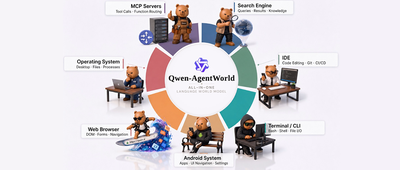
開源!阿里甩出首個語言世界模型,能造智能體環境
這篇消息聚焦「開源!阿里甩出首個語言世界模型,能造智能體環境」。原始導語提到:一個模型能模擬7種環境。 從 AI 情報角度來看,這類內容值得關注其背後的技術進展、產品落地、產業競爭與後續市場影響。