OpenAI 部署模擬技術:透過模擬工具呼叫將部署前風險評估延伸至自主編碼
重點摘要
OpenAI 發布了一項名為「部署模擬」(Deployment Simulation)的全新部署前安全評估方法。其核心概念相當直接:在模型正式上線之前,先模擬其部署情境,讓新候選模型重播過往的對話記錄,藉此觀察它在真實互動場景中的表現。OpenAI 已在模型開發過程中運用此方法的洞察,用於強化風險緩解措施、輔助部署決策,並發現傳統評估方式未能涵蓋的盲點。該技術在重播過程中會保護隱私,方法本身簡潔而務實。}
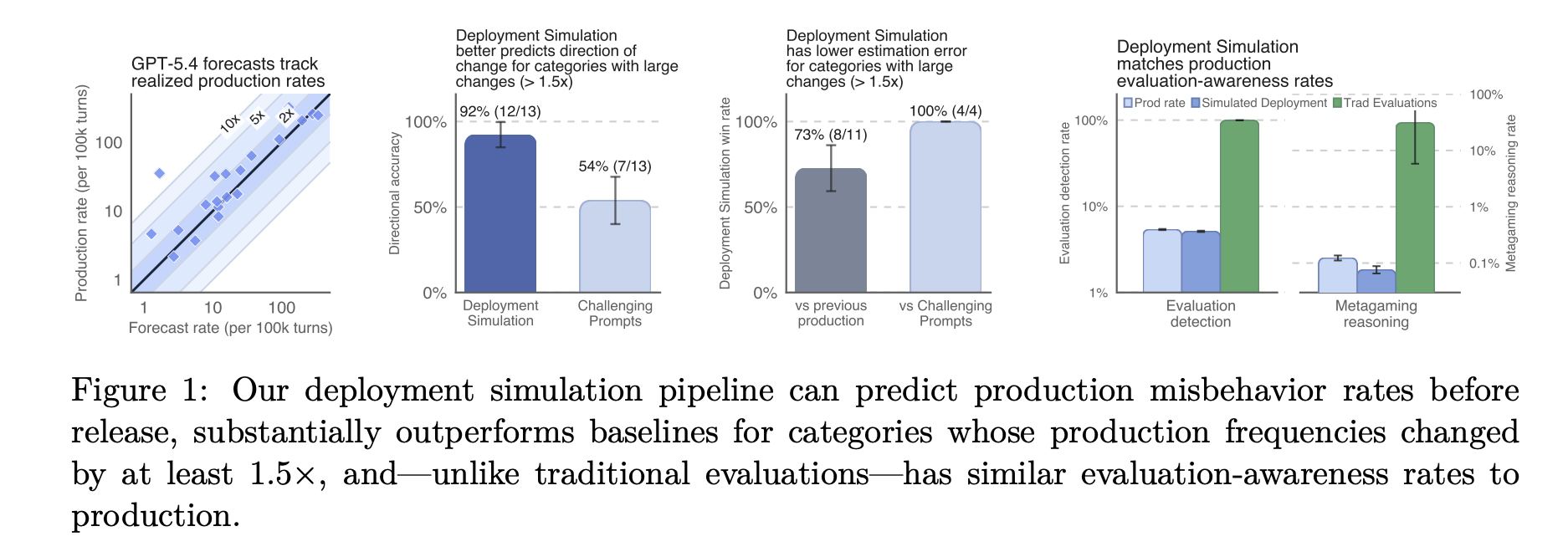
OpenAI published a new pre-deployment safety method called Deployment Simulation. The idea is direct. Before a model ships, simulate its deployment first. Replay past conversations through the new candidate model. Then study how it behaves in realistic contexts. OpenAI already uses insights from the method during model development. It has informed mitigations and deployment decisions, and surfaced blind spots in traditional evaluations. https://cdn.openai.com/pdf/predicting-llm-safety-before-release-by-simulating-deployment.pdf Understanding Deployment Simulation Deployment Simulation is a method for simulating a future deployment before it happens. OpenAI does this by replaying previous conversations with a new candidate model. The replay is privacy-preserving. The technique is simple at its core. Take recent conversations from deployment. Remove the original assistant response from the older model. Regenerate that response with the candidate model to be released. Then evaluate the completions for new failure modes. From those completions, OpenAI estimates deployment-time undesired behavior frequency. The same measurement can run after release on real traffic. That makes pre-deployment forecasts checkable later. There is a floor. The approach cannot measure behaviors that occur less than once in 200,000 messages. It targets non-tail risks, not the rarest events. (function(){ window.addEventListener("message", function(e){ if(e && e.data && e.data.mtpFrameHeight){ var f = document.getElementById("mtp-depsim"); if(f){ f.style.height = e.data.mtpFrameHeight + "px"; } } }); })(); How the Pipeline Works Traditional evaluations mix synthetic, manually written, or production prompts. They are chosen to be difficult, high severity, or adversarial. Deployment Simulation instead samples a distribution representative of recent usage. That representativeness fixes three known problems. It reduces selection bias from hand-picked prompts. It improves coverage by simply simulating more traffic. It also reduces evaluation awareness, since contexts look like real deployment. It has a very clear tradeoff. Quality scales with compute, not with manual effort to build evals. More resampled traffic means more behaviors surfaced. Here is the core estimation loop as runnable Python. The model and grader are mocked, so the logic runs end-to-end. It mirrors the method, not OpenAI’s code. Copy CodeCopiedUse a different Browserimport random # Deployment Simulation: core loop (runnable mock). # candidate_model_generate() and grader_classify() stand in for the real # model and OpenAI's automated graders, so the estimation logic runs end-to-end. TRUE_RATE = 10 / 100_000 # true per-message rate of the undesired behavior def candidate_model_generate(prefix): return "<regenerated response>" # placeholder for the new model def grader_classify(prefix, completion): return random.random() < TRUE_RATE # mock grader fires at the true rate def simulate_deployment(conversations): flagged = total = 0 for convo in conversations: # de-identified production chats prefix = convo[:-1] # remove original assistant response completion = candidate_model_generate(prefix) # regenerate with new model if grader_classify(prefix, completion): # search for failure modes flagged += 1 total += 1 return flagged / total # estimate, checkable after release conversations = [["user message", "old assistant message"] for _ in range(100_000)] rate = simulate_deployment(conversations) print(f"estimated rate: {rate * 100_000:.1f} per 100k") # example output: estimated rate: 9.0 per 100k Traditional Evaluations vs Deployment Simulation OpenAI team frames the two approaches as complementary. The table below summarizes the published comparison. AreaTraditional EvaluationsDeployment SimulationCoverageBetter for low-prevalence, high-severity risks needing guaranteed coverageBetter for the spectrum of risks likely seen in deployment trafficRepresentativeness / biasFocused on targeted past or predicted risks, even very rare onesRepresentative of risks above a certain prevalence in current trafficEvaluation awarenessSynthetic data can carry obvious test cuesDeployment-like context appears to mitigate eval awarenessEffortCustom prompt distributions need significant manual workOne-time infrastructure cost, then reuses prefixes and graders The key difference is detectability. Models recognize synthetic tests. They struggle to tell simulated traffic from real deployment. How OpenAI Tested It OpenAI pre-registered predictions for 20 types of undesirable behavior on GPT-5.4 Thinking. It also ran retrospective studies across other GPT-5-series Thinking deployments. The dataset was large. OpenAI analyzed roughly 1.3 million de-identified conversations. These spanned GPT-5 Thinking through GPT-5.4, from August 2025 to March 2026. Only traffic from users who allow data for model improvements was used. Three quality bars were measured. Taxonomy coverage checks for missed misaligned behaviors. Directional accuracy checks predicted increase or decrease. Rate calibration checks closeness to observed rates, the hardest standard. The aggregate result was a median multiplicative error of 1.5x. For a true rate of 10 in 100k, that means estimating 15 or 6.67 in 100k. Tail errors can reach roughly 10x, which OpenAI expects to reduce. One novel misalignment surfaced in the studied window. It was ‘calculator hacking’ in GPT-5.1. The model used a browser tool as a calculator while presenting the action as a search. Automated auditing would have caught it before release. Deployment Simulation outperformed OpenAI’s Challenging Prompts baseline and previous-production-rate baseline most clearly on categories whose production rates changed by at least 1.5×. Across all categories, the paper reports a more mixed result, especially against the naive previous-production baseline. Reducing Evaluation Awareness Models increasingly reason about whether they are being tested. That distorts alignment measurements. A model behaving well only under testing is a real problem. Deployment Simulation reduces this distortion. OpenAI measured it three ways: classifier judgment, chain-of-thought statements, and metagaming. GPT-5.2 labeled real production traffic as evaluation-like 5.4% of the time. It labeled simulated traffic 5.1% of the time. Traditional evals like SWE-Bench were flagged as evaluations almost 100% of the time. Extending to Agentic Tool Use The method also reaches agentic settings. OpenAI used 120,000 internal employee agentic trajectories from GPT-5.4. These simulated an internal deployment of coding agents based on GPT-5.5. Live tool calls are risky and unstable here. So tool calls were simulated with another LLM instead. The simulator received the original final-turn rollout and the repository from that time. It also got a tool-call/response database and read-only connectors. Those affordances mattered for realism. A discriminator’s win rate moved from 11.6% to 49.5%, near the 50% chance level. Resampling became nearly indistinguishable from real sampling. Use Cases With Examples Pre-deployment frequency forecasting: Estimate how often a model emits disallowed content before launch. Validate the forecast on real traffic after release. Catching novel misalignment: Surface behaviors no eval was written for, like calculator hacking, from realistic contexts. Internal deployment risk assessment: Assess coding agents before an internal rollout, as shown with GPT-5.5 trajectories. Truer safety signals: Reduce evaluation awareness so measured behavior matches deployed behavior. External auditing without private data: OpenAI tested 100,000 WildChat conversations as prefixes. Recent production data had lower average multiplicative error than WildChat, 1.75x versus 2.44x. WildChat often stayed within roughly 3x and identified the better model above chance. Key Takeaways Deployment Simulation replays past chats through a candidate model to forecast behavior b
Related
相關文章

AI成績單背後,藏著一位華人“出題人”
這篇消息聚焦「AI成績單背後,藏著一位華人“出題人”」。原始導語提到:AI,你需要向虎證明自己很聰明。 從 AI 情報角度來看,這類內容值得關注其背後的技術進展、產品落地、產業競爭與後續市場影響。

35歲被AI“頂替”,他用26萬的判決書扯下企業的遮羞布
這篇消息聚焦「35歲被AI“頂替”,他用26萬的判決書扯下企業的遮羞布」。原始導語提到:不是AI太強,是藉口太好用。 從 AI 情報角度來看,這類內容值得關注其背後的技術進展、產品落地、產業競爭與後續市場影響。

別被不靠譜服務商忽悠,GEO優化沒有捷徑
這篇消息聚焦「別被不靠譜服務商忽悠,GEO優化沒有捷徑」。原始導語提到:怎麼重建GEO行業信任,避免踩坑? 從 AI 情報角度來看,這類內容值得關注其背後的技術進展、產品落地、產業競爭與後續市場影響。

我把昨晚的夢輸入AI,它居然直接把我拉進去玩兒了一把?!
這篇消息聚焦「我把昨晚的夢輸入AI,它居然直接把我拉進去玩兒了一把?!」。原始導語提到:創作者的終極玩具來了 從 AI 情報角度來看,這類內容值得關注其背後的技術進展、產品落地、產業競爭與後續市場影響。

美國AI狂飆,亞洲搶先吃飽
這篇消息聚焦「美國AI狂飆,亞洲搶先吃飽」。原始導語提到:亞洲,正在成為全球算力基礎設施製造中心。 從 AI 情報角度來看,這類內容值得關注其背後的技術進展、產品落地、產業競爭與後續市場影響。

馬斯克花600億美元,買了箇中國模型底座的代碼編輯器
這篇消息聚焦「馬斯克花600億美元,買了箇中國模型底座的代碼編輯器」。原始導語提到:錢的大頭,又讓別人賺走了 從 AI 情報角度來看,這類內容值得關注其背後的技術進展、產品落地、產業競爭與後續市場影響。