Top 6 No-Code Tools for AI Engineers/Developers
重點摘要
In today’s AI-driven world, no-code tools are transforming how people create and deploy intelligent applications. They empower anyone—regardless of coding expertise—to build solutions quickly and efficiently. From developing enterprise-grade RAG systems to designing multi-agent workflows or fine-tuning hundreds of LLMs, these platforms dramatically reduce development time and effort. In this article, we’ll explore six powerful no-code tools that make building AI solutions faster and more accessible than ever. Atoms* Atoms is a no-code platform purpose-built for people who want to ship real products, not just prototypes. AI engineers and developers can use it to rapidly validate and build new products without getting bogged down in infrastructure setup. Key features: Zero Infrastructure Has
In today’s AI-driven world, no-code tools are transforming how people create and deploy intelligent applications. They empower anyone—regardless of coding expertise—to build solutions quickly and efficiently. From developing enterprise-grade RAG systems to designing multi-agent workflows or fine-tuning hundreds of LLMs, these platforms dramatically reduce development time and effort. In this article, we’ll explore six powerful no-code tools that make building AI solutions faster and more accessible than ever. Atoms* Atoms is a no-code platform purpose-built for people who want to ship real products, not just prototypes. AI engineers and developers can use it to rapidly validate and build new products without getting bogged down in infrastructure setup. Key features: Zero Infrastructure Hassle: Eliminates the need for backend configuration, allowing creators in the AI space to move fast without compromising on final output quality. Multi-Agent Architecture: Coordinates specialized AI roles—including a Deep Researcher, Product Manager, Engineer, SEO Specialist, and Ads Manager—covering everything from initial ideation to customer acquisition in a single environment. Instant Model Integrations: Connects seamlessly with leading models like GPT and Gemini right out of the box, requiring no manual API key configuration. Production-Ready Focus: Built specifically to help users deploy and scale actual market-ready products quickly rather than basic test environments. Sim AI Sim AI is an open-source platform for visually building and deploying AI agent workflows—no coding required. Using its drag-and-drop canvas, you can connect AI models, APIs, databases, and business tools to create: AI Assistants & Chatbots: Agents that search the web, access calendars, send emails, and interact with business apps. Business Process Automation: Streamline tasks such as data entry, report creation, customer support, and content generation. Data Processing & Analysis: Extract insights, analyze datasets, create reports, and sync data across systems. API Integration Workflows: Orchestrate complex logic, unify services, and manage event-driven automation. Key features: Visual canvas with “smart blocks” (AI, API, logic, output). Multiple triggers (chat, REST API, webhooks, schedulers, Slack/GitHub events). Real-time team collaboration with permissions control. 80+ built-in integrations (AI models, communication tools, productivity apps, dev platforms, search services, and databases). MCP support for custom integrations. Deployment options: Cloud-hosted (managed infrastructure with scaling & monitoring). Self-hosted (via Docker, with local model support for data privacy). RAGFlow RAGFlow is a powerful retrieval-augmented generation (RAG) engine that helps you build grounded, citation-rich AI assistants on top of your own datasets. It runs on x86 CPUs or NVIDIA GPUs (with optional ARM builds) and provides full or slim Docker images for quick deployment. After spinning up a local server, you can connect an LLM—via API or local runtimes like Ollama—to handle chat, embedding, or image-to-text tasks. RAGFlow supports most popular language models and allows you to set defaults or customize models for each assistant. Key capabilities include: Knowledge base management: Upload and parse files (PDF, Word, CSV, images, slides, and more) into datasets, select an embedding model, and organize content for efficient retrieval. Chunk editing & optimization: Inspect parsed chunks, add keywords, or manually adjust content to improve search accuracy. AI chat assistants: Create chats linked to one or multiple knowledge bases, configure fallback responses, and fine-tune prompts or model settings. Explainability & testing: Use built-in tools to validate retrieval quality, monitor performance, and view real-time citations. Integration & extensibility: Leverage HTTP and Python APIs for app integration, with an optional sandbox for safe code execution inside chats. Transformer Lab Transformer Lab is a free, open-source workspace for Large Language Models (LLMs) and Diffusion models, designed to run on your local machine—whether that’s a GPU, TPU, or Apple M-series Mac—or in the cloud. It enables you to download, chat with, and evaluate LLMs, generate images using Diffusion models, and compute embeddings, all from one flexible environment. Key capabilities include: Model management: Download and interact with LLMs, or generate images using state-of-the-art Diffusion models. Data preparation & training: Create datasets, fine-tune, or train models, including support for RLHF and preference tuning. Retrieval-augmented generation (RAG): Use your own documents to power intelligent, grounded conversations. Embeddings & evaluation: Calculate embeddings and assess model performance across different inference engines. Extensibility & community: Build plugins, contribute to the core application, and collaborate via the active Discord community. Llama Factory LLaMA-Factory is a powerful no-code platform for training and fine-tuning open-source Large Language Models (LLMs) and Vision-Language Models (VLMs). It supports over 100 models, multimodal fine-tuning, advanced optimization algorithms, and scalable resource configurations. Designed for researchers and practitioners, it offers extensive tools for pre-training, supervised fine-tuning, reward modeling, and reinforcement learning methods like PPO and DPO—along with easy experiment tracking and faster inference. Key highlights include: Broad model support: Works with LLaMA, Mistral, Qwen, DeepSeek, Gemma, ChatGLM, Phi, Yi, Mixtral-MoE, and many more. Training methods: Supports continuous pre-training, multimodal SFT, reward modeling, PPO, DPO, KTO, ORPO, and more. Scalable tuning options: Full-tuning, freeze-tuning, LoRA, QLoRA (2–8 bit), OFT, DoRA, and other resource-efficient techniques. Advanced algorithms & optimizations: Includes GaLore, BAdam, APOLLO, Muon, FlashAttention-2, RoPE scaling, NEFTune, rsLoRA, and others. Tasks & modalities: Handles dialogue, tool use, image/video/audio understanding, visual grounding, and more. Monitoring & inference: Integrates with LlamaBoard, TensorBoard, Wandb, MLflow, and SwanLab, plus offers fast inference via OpenAI-style APIs, Gradio UI, or CLI with vLLM/SGLang workers. Flexible infrastructure: Compatible with PyTorch, Hugging Face Transformers, Deepspeed, BitsAndBytes, and supports both CPU/GPU setups with memory-efficient quantization. AutoAgent AutoAgent is a fully automated, self-developing framework that lets you create and deploy LLM-powered agents using natural language alone. Designed to simplify complex workflows, it enables you to build, customize, and run intelligent tools and assistants without writing a single line of code. Key features include: High performance: Achieves top-tier results on the GAIA benchmark, rivaling advanced deep research agents. Effortless agent & workflow creation: Build tools, agents, and workflows through simple natural language prompts—no coding required. Agentic-RAG with native vector database: Comes with a self-managing vector database, offering superior retrieval compared to traditional solutions like LangChain. Broad LLM compatibility: Integrates seamlessly with leading models such as OpenAI, Anthropic, DeepSeek, vLLM, Grok, Hugging Face, and more. Flexible interaction modes: Supports both function-calling and ReAct-style reasoning for versatile use cases. Lightweight & extensible: A dynamic personal AI assistant that’s easy to customize and extend while remaining resource-efficient. *we do make a small Affiliate commission by adding an affiliate url. The post Top 6 No-Code Tools for AI Engineers/Developers appeared first on MarkTechPost.
Related
相關文章
軟件沒被AI殺死,但全球市場都捲上天了
AI寫程式能力崛起,但軟體並未被取代,反而在全球市場面臨更加激烈的競爭。軟體開發的門檻降低,促使各國廠商紛紛投入,導致市場「捲」上加「捲」。軟體業者需在效率與創新之間找到新平衡,才能應對這場無止境的挑戰。

Token管夠的時代結束了
這篇消息聚焦「Token管夠的時代結束了」。原始導語提到:企業的錢也不是大風颳來的 從 AI 情報角度來看,這類內容值得關注其背後的技術進展、產品落地、產業競爭與後續市場影響。
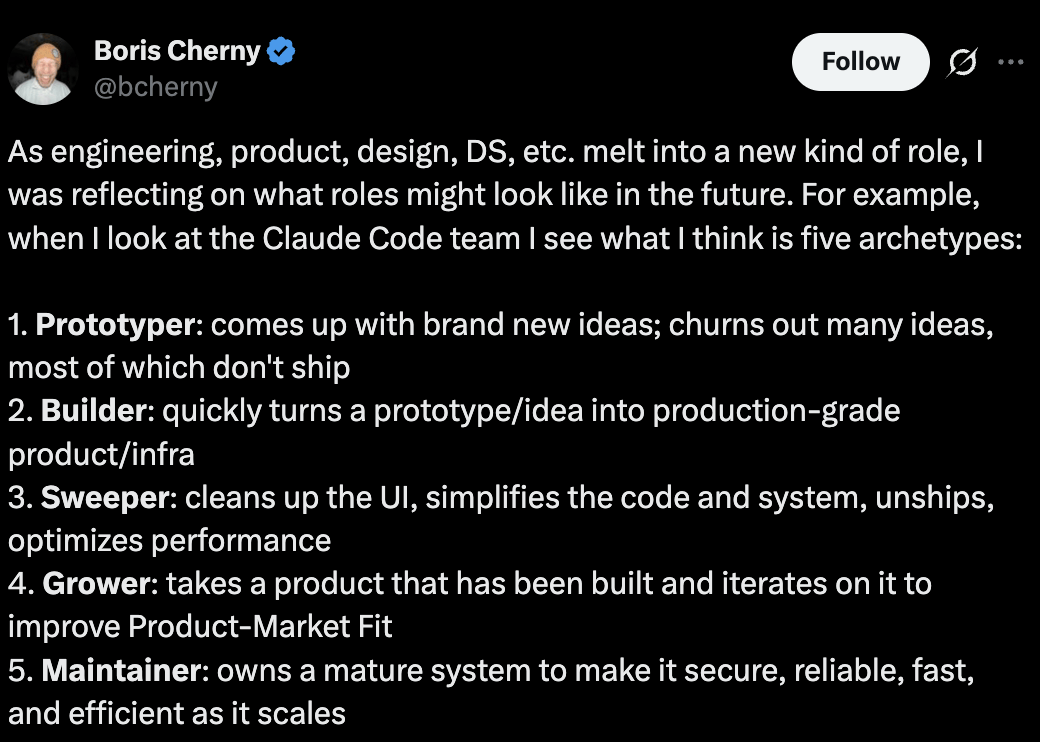
Claude Code之父版「職場MBTI」:AI洗牌後只剩5類人,你選哪種?
這篇消息聚焦「Claude Code之父版「職場MBTI」:AI洗牌後只剩5類人,你選哪種?」。原始導語提到:未來是屬於這5種職業的 從 AI 情報角度來看,這類內容值得關注其背後的技術進展、產品落地、產業競爭與後續市場影響。
中國信通院牽頭,首個智算運維智能體評測基準正式落地,覆蓋 5 款主流國產芯片
6月29日,在中國信通院人工智能軟硬件協同創新與適配驗證中心、中國人工智能產業發展聯盟、工信部人工智能標準化技術委員會聯合主辦的2026“眾智”大模型開放智算生態協同高級別研討會中,中國信通院副院長魏亮,正式發佈AISHPerf人工智能軟硬件基準體系3.0版本,包含兩項 AI Infra 領域核心評測基準——AISHPerf-智算運維智能體評測基準以及AISHPerf-算子生成智能體評測基準,兩大基準由國內頂尖AI原生基礎設施服務商無問芯穹及清華大學團隊作為重點技術支持方參與建設。前者是首個面向 AI Infra 的運維智能體評測基準,依託百億級真實運維數據構建,核心考核智算運維智能體在真實生產場景中解決實際問題的落地能力。後者則跳出 “模型能否生成可運行 GPU 算子” 的基礎維度,將評測重心錨定在 “模型生成的算子能否在真實量化推理部署中替代現有算子” 的工程可部署性上,更貼合產業實際落地需求。二者從底層算力優化到上層集群運維,共同為智算產業的標準化升級與高質量發展提供了統一的能力參照框架。 AISHPerf(Performance Benchmarks of Artificial Intelligence Software and Hardware)是中國信通院與人工智能大模型及軟硬件評測工業和信息化部重點實驗室,依託人工智能軟硬件協同創新與適配驗證中心(位於國家信創園)聯合構建的人工智能軟硬件基準體系,旨在設置多維度指標,考察端到端方案對模型及應用場景的真實承載能力,系統評估軟硬件各層級間的協同優化水平、兼容適配能力及整體交付效能。在此次發佈的兩項基準中,AISHPerf-智算運維智能體評測基準尤為引人注目,它不僅標誌著我國在智算集群運維智能體領域擁有了首個權威評測體系,更率先將國產芯片集群運維場景納入評測體系、填補了國產智算運維智能體評測領域的空白,為構建自主自治
Hermes新功能上線!比Opus 4.8和GPT-5.5還猛
AI應用風向標(公眾號:ZhidxcomAI) 作者|畢偉豪 編輯|漠影 智東西6月30日報道,現在,Fable 5和Mythos 5等頂尖閉源模型沒法使用,就算能用,單一模型也總有搞不定的問題,那麼,想要高質量輸出結果的用戶該怎麼辦呢? 近日,Hermes Agent上線了MoA(Mixture of Agents)功能,支持用戶自由組合多種模型作為虛擬模型使用,在Nous Research即將發佈的基準測試中,這個混合模型的評分超過了Opus 4.8 和GPT-5.5。 一、Fable 5、Mythos 5被禁,多模型組合成為潮流 Nous Research在官推上說了這樣一句話:“最強大的模型是受限的,只有少數人才能獲得訪問權限。”這句話明晃晃地指向了Fable 5等模型被封禁的事件。 在這種背景下,不難看出,MoA這個混合模型模式的終極目的,是用開源模型的組合達到頂尖閉源模型的水準,就像Hermes Agent聯合創始人Teknium說的,他們正在測試各種開源模型組合,看看是否能用更便宜的模型達到Opus的水平。 這種多模型組合比肩頂尖模型的思路,最近其實有不少實踐的例子,比如前段時間日本AI獨角獸Sakana AI發佈的Sakana Fugu系列編排器模型,會根據任務選擇最佳的模型來處理,和MoA的思路非常相似。 而MoA的技術也在很久之前就已存在了,2024年6月Together AI曾發表過一篇論文《Mixture-of-Agents Enhances Large Language Model Capabilities》,核心是多LLM組合,每一層模型都會參考上一層模型的輸出,再繼續生成自己的回答。同時,論文也將模型分成了兩類,也就是現在Hermes所用的參考模型和聚合模型。 當用戶提出問題時,參考模型會先對問題進行分析判斷,然後給出參考意見,隨後由聚合模型來
Claude Code之父最新判斷:AI時代團隊分工被重寫,這「五種人」最吃香
這篇消息聚焦「Claude Code之父最新判斷:AI時代團隊分工被重寫,這「五種人」最吃香」。原始導語提到:工程師、PM、設計師……崗位邊界正在消失! 從 AI 情報角度來看,這類內容值得關注其背後的技術進展、產品落地、產業競爭與後續市場影響。