代理安全缺口:54%企業已遭遇AI代理事故,多數仍讓代理共享憑證
重點摘要
在107家企業中,AI代理被賦予實際系統與資料的存取權限,但其管控機制卻遠遠落後。超過半數企業已確認發生代理安全事件或險些事故;僅約三分之一為每個代理分配專屬身分,多數代理仍共享憑證;只有三成企業隔離最高風險的代理。安全防護堆疊大多來自模型供應商與超大型雲端業者,而非專為代理打造;安全預算僅佔極小比例;企業對於自身防禦能否跟上AI攻擊者腳步的看法分歧。結果形成代理安全缺口——自主代理擴散速度遠超過所需的身分、隔離與執行控制機制。
Across 107 enterprises, AI agents are being given real access to systems and data while the controls meant to contain them lag behind.
More than half have already had a confirmed agent security incident or a near-miss; only about a third give every agent its own scoped identity, and most agents still share credentials; and only three in ten isolate their highest-risk agents.
The security stack is overwhelmingly borrowed from the model providers and hyperscalers rather than purpose-built for agents, spending remains a thin slice of the security budget, and enterprises are evenly split on whether their defenses are keeping pace with AI-enabled attackers.
The result is an agent security gap — autonomous agents proliferating faster than the identity, isolation, and enforcement controls needed to hold them.
This wave of VentureBeat Pulse Research examines how enterprises secure their AI agents: what tooling they run, how they manage agent identity and isolation, what has already gone wrong, how much they spend, and whether they believe their defenses are keeping pace with AI-enabled attackers.
The central finding is an agent security gap — the distance between the autonomy enterprises are granting their agents and the controls in place to contain them.
More than half of organizations (54%) have already experienced a confirmed agent security incident (18%) or a near-miss caught before harm (36%).
The structural weakness beneath those numbers is identity: only about a third (32%) give every agent its own scoped, managed identity, while the rest report that some agents share credentials or that agents mostly run on shared API keys and human or service-account credentials.
When agents share credentials, a single compromised or over-permissioned agent carries a wide blast radius — and only three in ten enterprises (30%) isolate their highest-risk agents in sandboxes to bound that radius.What makes the gap notable is how comfortable enterprises are inside it.
The security stack is overwhelmingly provider-native — OpenAI’s guardrails (51%), Google’s and Microsoft’s cloud controls, and Anthropic’s managed-agent controls dominate, while the dedicated agent-security specialists barely register — and satisfaction with that borrowed stack is high, averaging 4.
2 out of 5.Yet spending remains a thin slice of the security budget, only a third of enterprises believe their AI defenses are ahead of AI-enabled attackers, and a clear majority plan to change tooling within the year.
Enterprises are satisfied with controls they are simultaneously preparing to replace.
MethodologyVentureBeat fielded this survey as part of its ongoing Pulse Research series, this instrument focused on enterprise agent security — the tooling, identity, isolation, and enforcement controls organizations use to secure autonomous AI agents.
Responses are filtered to organizations with more than 100 employees (n=107; the survey’s smallest size band, 1–100 employees, is excluded), drawn from a single June 2026 wave.
Because this is one wave rather than a pooled multi-month sample, the report reads cross-sectionally and does not infer month-over-month trends.Several questions were multiple-select, so those shares can sum to more than 100%.
By role the sample is senior and buyer-credible: 45% are final decision-makers for AI purchases and another 30% recommenders or influencers.Managers (43%), individual contributors (24%), VPs and directors (15%), and the C-suite (11%) make up the seniority mix.
By organization size the sample is mid-market-weighted: 251–1,000 (42%) and 101–250 (25%) employees lead, with 1,001–5,000 (19%), 5,001–10,000 (8%), and 10,001+ (7%) above them.
Technology/Software is the largest industry at 23%, followed by Manufacturing (15%), Retail/E-commerce (14%), and Healthcare/Life Sciences (13%).
At 107 respondents the sample is large enough to read directionally but should be treated as a directional signal rather than a precise measurement; it is self-selected and is not a probability sample.
It skews toward the mid-market, so it is best read as the view from organizations actively standing up agent security rather than from the largest operators.
Satisfaction ratings are computed on the respondents who answered each rating question; the overall satisfaction score reflects 82 of the 107 qualified respondents.
Finding 1: The incidents are already hereMore than half have had an agent security incident or near-missWe asked whether organizations had experienced an agent security incident — a confirmed breach, or a near-miss caught before harm.Most that run agents in production had.
This is the report’s defining number.More than half of organizations (54%) have already had an agent security event — 18% a confirmed incident and 36% a near-miss caught before it caused harm.
Only 42% report nothing, and a small remainder either run no agents in production or don’t track such events.That so many report near-misses rather than only confirmed incidents is telling: enterprises are catching problems, but they are catching them close to the edge.
The controls examined in the rest of this report — identity, isolation, enforcement — are what determine whether the next near-miss stays a near-miss.Exposure scales with company size, but containment does not.
The incident-or-near-miss rate rises from 49% in the mid-market (companies with 101-1,000 employees) to 63% at larger enterprises (above 1,000 employees), while sandbox isolation of high-risk agents falls from 35% to 20%, and satisfaction with security tooling drops from 4.36 to 3.97.
The organizations running the most agents across the most systems carry the most incidents and the least of the one control that bounds an incident's blast radius.
Finding 2: The identity gapOnly a third give every agent its own scoped identityWe asked how enterprises manage the identity of their AI agents — whether each agent has its own credentials, or agents share them.Full per-agent identity is the exception.
Rolled together, the overlapping answers show 69% of enterprises (74 of 107) with credential sharing somewhere in the agent fleet.Identity is the structural weakness beneath the incidents.
Only about a third of enterprises (32%) give every agent its own scoped, managed identity — the precondition for least-privilege access and clean attribution.
Nearly half (48%) say some agents have scoped identities but many still share credentials, and another 32% say agents mostly run on shared API keys or borrowed human and service-account credentials.(Respondents could describe more than one pattern across their agent fleet, so these overlap.
) The consequence is direct: when agents share credentials, an over-permissioned or compromised agent can act with far more reach than intended, and forensics after an incident cannot cleanly tell which agent did what.
The non-human identity problem — giving every agent its own governed identity — is the single largest unfinished piece of enterprise agent security.Moreover, a company’s agent credential posture is correlated with incidents.
Organizations with credential sharing anywhere in the fleet were hit — with an incident or a near-miss in the past twelve months — at 63.5% (47 of 74).Organizations where every agent carries its own scoped identity were hit at 40.9% (9 of 22).
The fully-scoped group is small, so for now the relationship is an association rather than proven causation, and the gap is concentrated in the mid-market — but within a single survey, a twenty-three point difference in incident rate suggests significance.
Finding 3: Observe and enforce, but rarely isolateOnly three in 10 sandbox their highest-risk agentsWe asked what an organization’s agent security posture looks like in practice — whether they observe, enforce, isolate, or some combination.The control that bounds damage is the least common.
Monitoring and enforcement are reasonably common; containment is not.Roughly half of enterprises observe agent activi
Related
相關文章

當 human in the loop 變成“閉著眼睛點確認”,企業Agent 安全還能靠誰?
專家指出,AI Agent 從內容安全轉向行為安全,提示詞注入、工具濫用與過度授權成為主要風險。企業應建立可視、可管、可追溯的安全基線,並對工具權限進行最小化與臨時化管理,避免 human in the loop 淪為形式。安全防護需從靜態入口轉向動態行為約束,以因應 Agent 自主執行帶來的全新挑戰。

開源Agent框架刷爆ARC-AGI-3,「自我改進」的RLM harness引爭議
一套開源Agent框架在ARC-AGI-3基準測試中創下超過85%的正確率,大幅領先其他解決方案,其核心是名為「RLM harness」的自我改進機制。然而,該方法引發學術爭議,部分研究者批評它透過反覆試錯「鑽漏洞」,不符合ARC-AGI評測一次性推理的精神。這場討論促使AI社群重新審視評測標準,並可能影響未來ARC-AGI版本的設計方向。

騰訊是在“賽馬”,還是在打造 “Agent工廠”?
騰訊內部正在探討其發展策略究竟是「賽馬」機制還是打造「Agent工廠」。相關討論聚焦於公司如何平衡內部競爭與統一平台建設。目前站內已移除相關混雜文字,保留原始主題供讀者參考。
ChinaJoy 2026 AI遊戲規模化落地,邊緣雲與API安全重構產業底層邏輯
2026年ChinaJoy展館,“與AI同遊”的主題隨處可見。行業調查顯示,僅有21%的企業擁有完整的API資產清單,大量後臺AI接口仍在無人監控的狀態下裸奔。合規與安全也同步下沉。算力下沉還不夠,API安全必須同步前移邊緣雲解決了體驗問題,但AI交互入口的安全,同樣需要前置到邊緣。算力與安全,缺一不可Akamai的判斷很明確:遊戲AI轉型不能割裂算力與安全。這也是遊戲廠商規模化落地AI智能體、構建AI原生遊戲的標準化底層方案。
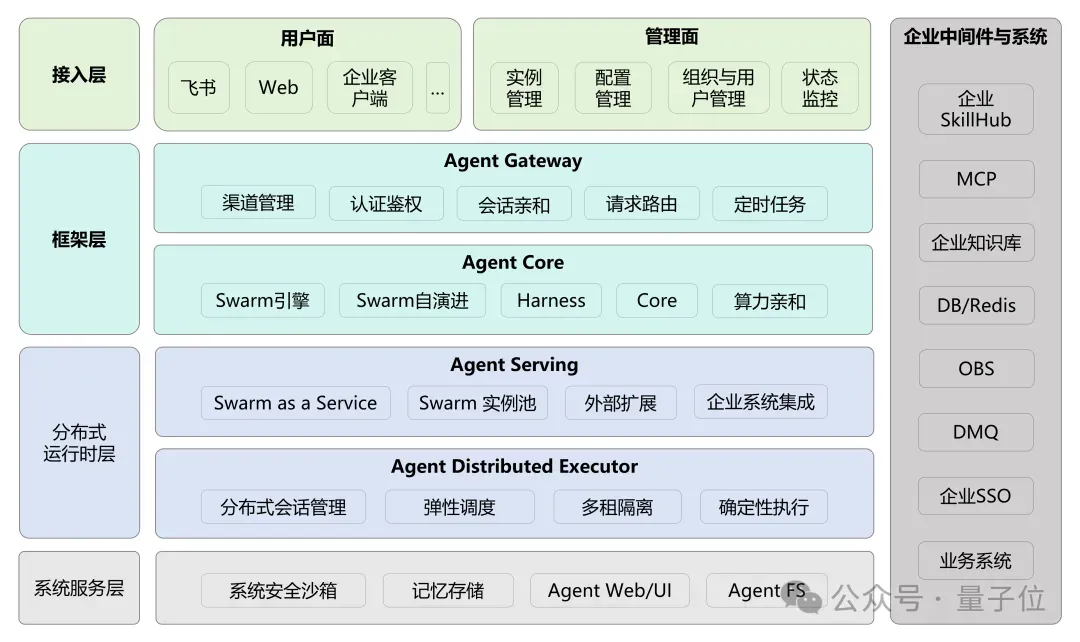
openJiuwen發佈業界首個企業級分佈式蜂群架構,聯合郵儲成功落地金融生產環境
< img id="wx_img" src="https://www.qbitai.com/wp-content/uploads/imgs/qbitai-logo-1.

螞蟻集團開源Avernet,讓人與智能體像組織一樣高效協作
**螞蟻集團開源Avernet:打造人與智能體高效協作的“組織級”基礎設施** **來源:量子位** **2026-08-07 11:08:51** 近日,螞蟻集團正式宣佈開源多智能體協作基礎設施Avernet,其社區版本已同步上線。作為業界首個聚焦於“組織級協作”的智能體基礎設施,Avernet的首個版本重點開放了智能體協作網絡能力,旨在支持不同智能體之間的發現、共識達成、跨團隊協作與治理,為人工智能從“單點智能”走向“系統智能”提供關鍵支撐。